
A bare shell-and-tube condenser is a compact and reliable water-cooled heat exchanger used to condense refrigerant vapor in refrigeration systems. It is commonly found in marine reefer units, cold storage systems, provision refrigeration plants, and industrial cooling equipment where stable heat rejection is required but installation space is limited.
Unlike finned air-cooled condensers, this design uses a smooth bare tube bundle inside a pressure shell. Cooling water flows through the tubes, while refrigerant flows on the shell side and releases heat as it changes from high-temperature vapor into liquid. Because water has much better heat-transfer capability than air, a shell-and-tube condenser can achieve strong cooling performance in a relatively small body size.
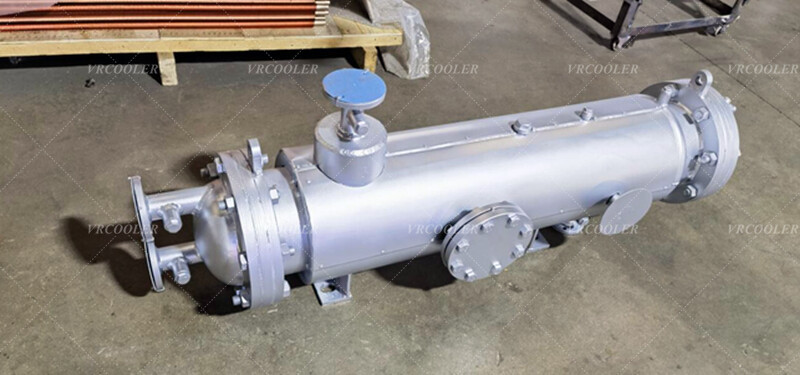
For the reefer condenser shown in the drawing, the unit is designed for R22 refrigerant service. The condenser has a compact horizontal shell body, with an overall length of around 1140 mm and a main shell length of about 1000 mm. The drawing also shows refrigerant pressure data of AP 20 kg/cm² and TP 30 kg/cm², with a shell volume of about 0.0277 m³. The cooling water side is separately tested, which is important because the refrigerant circuit and water circuit must remain completely isolated during operation.
In normal operation, hot refrigerant gas enters the condenser shell and contacts the outside surface of the bare tubes. Cooling water passes inside the tubes and removes the heat. As the refrigerant loses heat, it condenses into liquid and flows onward to the receiver or expansion device. A stable condenser keeps the refrigeration system working at the correct condensing pressure, improves compressor reliability, and helps maintain efficient cooling capacity.
The biggest advantage of a bare shell-and-tube condenser is its simple and durable structure. The bare tube design is easier to clean than many compact plate-type solutions, especially when the cooling water quality is not perfect. For marine or industrial projects, the tube material can be selected according to the water source. Copper tubes are often used for clean freshwater, while copper-nickel or titanium tubes are preferred when seawater, brackish water, or corrosive cooling water is involved.
Another benefit is maintenance convenience. The water side can usually be inspected, flushed, or mechanically cleaned during scheduled service. This is very important for reefer and marine refrigeration systems, because scale, mud, biological fouling, or salt deposits inside the tubes can reduce heat transfer and cause high condensing pressure. If the condenser is not cleaned in time, the compressor may run with higher load, higher discharge temperature, and lower system efficiency.
A well-designed bare shell-and-tube condenser should consider refrigerant type, condensing temperature, cooling water inlet temperature, water flow rate, allowable pressure drop, tube material, shell design pressure, test pressure, and installation space. For replacement projects, dimensions such as nozzle position, mounting distance, shell length, flange connection, and service clearance should also be checked carefully to make sure the new condenser can fit the existing refrigeration system.
For reefer refrigeration, marine cooling, and industrial chiller service, the bare shell-and-tube condenser remains a practical and dependable choice. It offers strong heat rejection, compact size, robust pressure resistance, and easy water-side maintenance. With the correct material selection and proper pressure testing before delivery, it can provide long service life and stable refrigeration performance in demanding operating environments.
