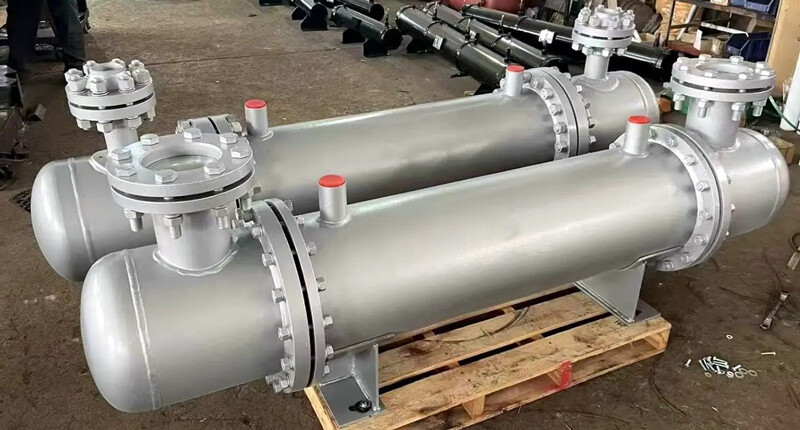
Core Heat Transfer Equipment Shell Tube Quench Condenser in Ethylene Production Processes
In ethylene production (the cornerstone of the petrochemical industry), the shell-and-tube quench condenser is a mission-critical heat transfer device. Its primary role is to rapidly "quench" (cool) the ultra-hot pyrolysis gas generated by steam cracking of hydrocarbons (e.g., naphtha, ethane, propane) and condense heavy hydrocarbon fractions—preventing secondary reactions (e.g., coking, polymerization) that degrade ethylene yield and damage downstream equipment.
Why Quench Condensers Are Indispensable in Ethylene Production
Ethylene is produced via steam cracking: hydrocarbons are mixed with superheated steam (850–950°C) and heated in a furnace for 0.1–0.5 seconds to break long-chain molecules into small olefins (ethylene, propylene, etc.). The outlet of the cracking furnace produces a pyrolysis gas (PG) with two critical characteristics that demand immediate quenching:
Extreme temperature: PG exits the furnace at 800–900°C. If not cooled rapidly, high temperatures trigger unwanted secondary reactions:
Coking: Carbon deposits form on equipment surfaces, blocking tubes and reducing heat transfer efficiency.
Polymerization: Unsaturated hydrocarbons (e.g., dienes) polymerize into viscous residues, fouling pipelines and valves.
Thermal decomposition: Ethylene itself may decompose into methane and carbon if held at high temperatures.
Complex composition: PG contains light components (H₂, CH₄, C₂H₄, C₃H₆) and heavy fractions (C₅+, aromatics, tars). Heavy fractions must be condensed and separated early to avoid contaminating downstream separation units (e.g., cryogenic distillation columns).
The shell-and-tube quench condenser solves these challenges by achieving two goals simultaneously: rapid cooling of PG (to 200–300°C in seconds) and selective condensation of heavy hydrocarbons—laying the foundation for efficient ethylene purification.
Working Principle: Dual Functions of Quenching and Condensation
The shell-and-tube quench condenser operates on the principle of countercurrent heat exchange between the hot pyrolysis gas (shell side) and a cooling medium (tube side). Its design is optimized to maximize heat transfer rate while minimizing fouling. Here’s a step-by-step breakdown:
Step 1: Fluid Circuit Configuration
Shell side (hot stream): The cylindrical shell of the exchanger contains the pyrolysis gas. PG enters the shell through a large-diameter inlet nozzle (sized to handle high gas flow rates) at the top or upper section of the exchanger. As it flows downward (or horizontally, depending on orientation), it comes into contact with the external surface of the tube bundle.
Tube side (cooling stream): A bundle of small-diameter tubes (typically 25–50 mm ID) runs through the shell, supported by baffles. The cooling medium—usually quench oil (a heavy hydrocarbon fraction recycled from downstream separation) or boiling water—flows through the tubes in the opposite direction (countercurrent) to PG:
Quench oil: Most common in naphtha-based ethylene plants. Cold quench oil (150–200°C) enters the tubes at the bottom of the exchanger, absorbs heat from PG, and exits at 250–300°C. Heated quench oil is then sent to a quench oil cooler (for re-cooling) and recycled back to the condenser.
Boiling water: Used in ethane/propane cracking plants (where PG has fewer heavy fractions). Water flows through the tubes and boils at low pressure (1–2 bar) to generate low-pressure steam, leveraging latent heat of vaporization for efficient heat transfer.
Step 2: Heat Transfer Mechanism
Quenching (sensible heat transfer): As hot PG flows over the tube surfaces, heat transfers through the tube wall to the cooling medium inside. The countercurrent flow maximizes the log mean temperature difference (LMTD)—a key metric for heat transfer efficiency. For example, if PG cools from 850°C to 250°C and quench oil heats from 180°C to 280°C, the LMTD is ~400°C—far higher than co-current flow, enabling rapid cooling.
Condensation (latent heat transfer): As PG cools below the dew point of its heavy fractions (C₅+, tars), these components condense into liquid droplets on the external tube surfaces. The liquid drains downward (aided by gravity and baffles) and collects at the bottom of the shell, where it is pumped to a heavy oil separation unit. Light components (H₂, C₂H₄, C₃H₆) remain gaseous and exit the shell at the bottom (or side) to proceed to downstream processing (e.g., primary fractionator).