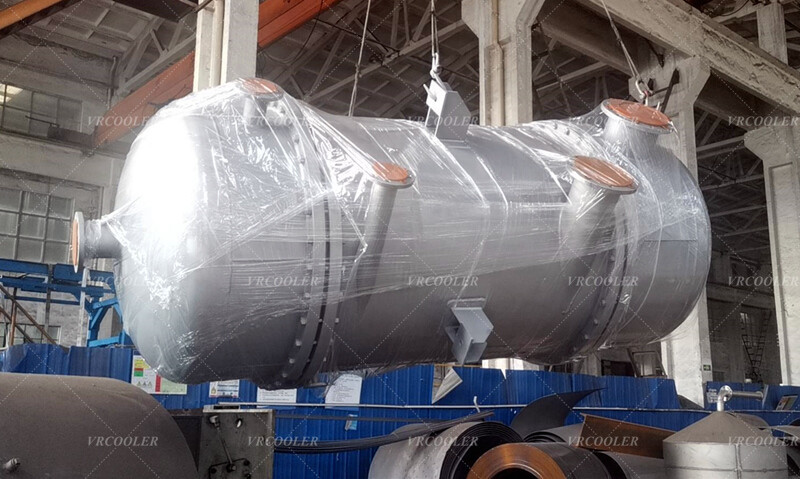
Heat Recovery Heat Exchangers For high temperature waste heat (above 300°C), Organic Rankine Cycle (ORC) power generation systems are used.
Principle
Organic Rankine cycle principle:
Evaporation process: In the evaporator, the low-boiling point organic substance absorbs the high-temperature waste heat from the heat recovery heat exchanger and transforms from liquid to gas. In this process, high-temperature waste heat as a heat source so that the internal energy of organic substances increased, the temperature and pressure rise.
Expansion work process: high-temperature and high-pressure gaseous organic matter into the expander, in which the expansion and external work, their own heat and pressure energy into mechanical energy, drive and the generator connected to the expander to generate electricity, similar to the role of the steam turbine in the traditional power generation system.
Condensation process: the low-pressure gaseous mass discharged from the expander enters the condenser, releases heat to the cooling medium (such as water or air), condenses to liquid state, the temperature and pressure are reduced, and restored to the initial state, in preparation for the next cycle.
Pump power process: liquid mass through the pump is pressurized back to the evaporator, to complete a complete cycle. The power consumed by the pump is far less than the power output of the expander, thus realizing the net power output of the whole system to the outside world.
Heat Recovery Heat Exchanger Principle: The heat recovery heat exchanger is used to transfer high-temperature waste heat to the organic mass in the organic Rankine cycle. It makes use of the temperature difference between different fluids, and through heat conduction and heat convection, the heat of high-temperature waste heat fluid is transferred to the organic work fluid, realizing the effective transfer of heat, and providing the required heat for the evaporation of the organic work fluid.
Advantage
Efficient use of thermal energy: Organic Rankine cycle can realize efficient evaporation at relatively low temperature, and for high temperature waste heat can be transferred to organic work material through heat recovery heat exchanger, so that the high temperature waste heat which may be wasted can be fully utilized to improve the efficiency of energy utilization.
Strong system adaptability: ORC system can use a variety of organic substances, according to different high-temperature waste heat temperature and characteristics of the selection of suitable substances, to adapt to different industrial application scenarios. And the system operating temperature and pressure is relatively low, high security, the requirements of the equipment is relatively less demanding.
Environmentally friendly: Some new organic substances have low ozone layer depletion potential (ODP) and global warming potential (GWP), with little negative impact on the environment. Compared to traditional high-pollution, high-emission power generation methods, ORC systems utilizing high-temperature waste heat in combination with heat recovery heat exchangers can reduce greenhouse gas emissions and environmental pollution.
Simple and compact system: Compared with some other high-temperature waste heat power generation technologies, the ORC system is relatively simple in structure, with less auxiliary equipment, a small footprint, and easy to install and maintain, which is advantageous in industrial sites with limited space.
Application Examples
Iron and steel mills: Take a steel mill with an annual output of 5 million tons of steel as an example, there are 500,000 cubic meters of flue gas in its exhaust port every hour. By using Organic Rankine Cycle (ORC) technology, on the one hand, it can realize the recovery of flue gas waste heat for power generation, which saves the steel mill nearly 200 million yuan of power purchase cost every year. On the other hand, using the cooling medium at the cold end of the organic Rankine cycle, it can provide a liquefied cold source for the carbon dioxide capture process in the flue gas, realizing an annual production of 1.35 million tons of carbon dioxide, which can be used for oil field oil repulsion or as a raw material for synthesizing methanol, and the annual revenue from the sale of carbon dioxide is about 360 million yuan.
Petrochemical industry: In the process of petrochemical production, many processes will produce a large amount of high temperature waste heat, such as the temperature of diesel fuel after hydrodesulfurization is 130℃-175℃, with a flow rate of 200t/h-390t/h. Through the configuration of the organic Rankine cycle waste heat and power generation system, it can cool down the refined diesel fuel, and at the same time use the remaining heat to generate electricity, and it can also exempt the air-cooler from consuming electricity, so as to realize a win-win situation of energy-saving and economic benefits.