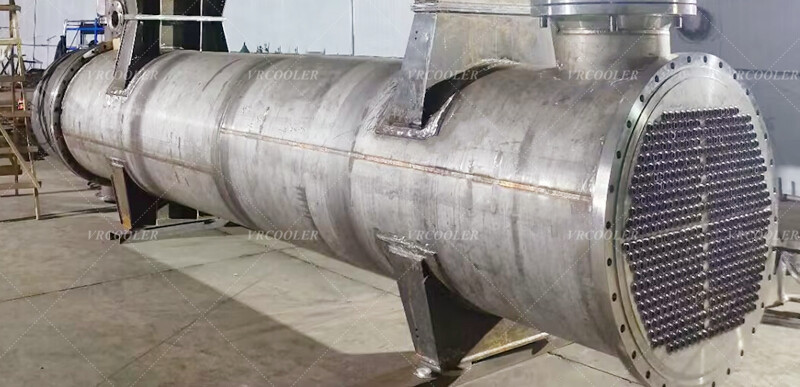
How Does the Steam Heat Transfer in a Shell and Tube Heat Exchanger?
Shell side: Steam (the hot fluid). Steam is routed through the shell (the outer cylindrical chamber) because it expands as it condenses, and the shell’s large volume accommodates this phase change without excessive pressure drop.
Tube side: Fresh water (the cold fluid). Fresh water flows through the internal tubes (bundles of small-diameter metal tubes) because tubes provide a large, uniform surface area for heat exchange and are easy to clean (critical for water quality).
Tube sheet: A metal plate that seals the ends of the shell and holds the tubes in place, separating the steam (shell) and water (tubes) to prevent mixing.
Steam transfers heat to fresh water through a sequential combination of phase change (condensation) and conduction/convection, with the tube wall acting as the critical "heat bridge." Here’s how each stage works:
Stage 1: Steam Condensation (Shell Side – Primary Heat Release)
Steam enters the shell at a temperature higher than the boiling point of water at the operating pressure (e.g., ~100°C at 1 atm, but higher for high-pressure steam). The key here is that steam releases massive amounts of latent heat (heat required for phase change) when it condenses into liquid water (condensate) – this is the single largest source of heat transfer in the process.
How condensation happens: Steam contacts the outer surface of the cold tubes (cooled by the fresh water inside). The tube wall temperature is lower than steam’s saturation temperature, so steam condenses on the tube surface.
Heat released: Latent heat is far more significant than "sensible heat" (heat that changes temperature without phase change). For example, 1 kg of steam at 1 atm releases ~2260 kJ of latent heat when condensing – enough to heat ~5.4 kg of fresh water from 20°C to 100°C.
Condensate drainage: The liquid condensate (now at steam’s saturation temperature) flows downward (due to gravity) to the bottom of the shell, where it is collected and removed via a condensate trap (prevents steam from escaping while draining liquid).
Stage 2: Conduction Through the Tube Wall
The latent heat released during condensation is transferred through the tube wall via conduction – the transfer of heat through a solid material (the tube metal) due to molecular vibration.
Key factors for conduction efficiency:
Tube material: Typically metals with high thermal conductivity, such as copper (401 W/m·K) or stainless steel (15–25 W/m·K). Copper is preferred for better heat transfer, while stainless steel is used for corrosive water or high-pressure applications.
Tube wall thickness: Thinner walls improve conduction (heat loss decreases with thickness), but walls must be thick enough to withstand operating pressures (e.g., 1–2 mm for low-pressure systems, thicker for high-pressure steam).
Stage 3: Convection to Fresh Water (Tube Side – Heat Absorption)
Finally, the heat conducted through the tube wall is transferred to the cold fresh water inside the tubes via forced convection (since water is pumped through the tubes at a controlled velocity).
How convection works: The water flowing past the tube’s inner surface absorbs heat, increasing its temperature (sensible heat gain). Turbulent flow (achieved by designing tube diameter and water velocity) is critical here – it breaks up the thin "boundary layer" of stagnant water near the tube wall, which otherwise acts as a thermal barrier.
Temperature change: The fresh water exits the tubes at a higher target temperature (e.g., 50–90°C, depending on the application, such as space heating or industrial processes).