
A marine atmospheric condenser plays an important role in keeping shipboard refrigeration and cooling systems running safely and efficiently. In marine environments, the condenser must do more than reject heat. It also has to withstand salt-laden air, limited installation space, vibration, varying cooling-water quality, and continuous operation under demanding conditions. That is why the design of a marine atmospheric condenser is never simply about surface area. It is about matching real onboard operating conditions, controlling fouling risk, and ensuring stable heat exchange performance over time.
For marine refrigeration and chilled water systems, the condenser is the component that releases the heat absorbed from the evaporator and compression cycle. When this process is stable, the whole system performs better. Condensing pressure stays under control, compressor load remains reasonable, and the chilled water side can maintain the target outlet temperature more reliably. On ships and offshore platforms, this is especially important because cooling equipment often works in high ambient temperature conditions and must continue operating even when seawater temperature rises.
In this project, the marine atmospheric condenser is designed for a condensing temperature of 40°C. For the fresh water cooling condition, the cooling water enters at 30°C and leaves at 35°C, with a subcooling degree of 5°C and a fouling factor of 0.000043 m²·K/W. For the sea water cooling condition, the cooling water enters at 32°C and leaves at 36°C, with a subcooling degree of 4°C and a fouling factor of 0.000086 m²·K/W. These design conditions clearly show the practical differences between fresh water and sea water service. Seawater usually brings a higher fouling risk and greater corrosion concern, so the condenser must be designed with more careful attention to material selection, wall thickness, water velocity, and maintenance accessibility.
Compared with land-based equipment, a marine condenser often faces harsher service conditions. Salt content, suspended solids, biological growth, and scaling all affect long-term performance, especially on the seawater side. That is why the fouling factor for seawater service is higher than that for fresh water in this design case. A properly engineered marine atmospheric condenser must take this into account from the beginning, rather than only when performance starts to decline. In practical terms, this means choosing suitable tube materials such as copper nickel, titanium, stainless steel, or other corrosion-resistant options depending on the vessel type, water quality, and maintenance strategy.
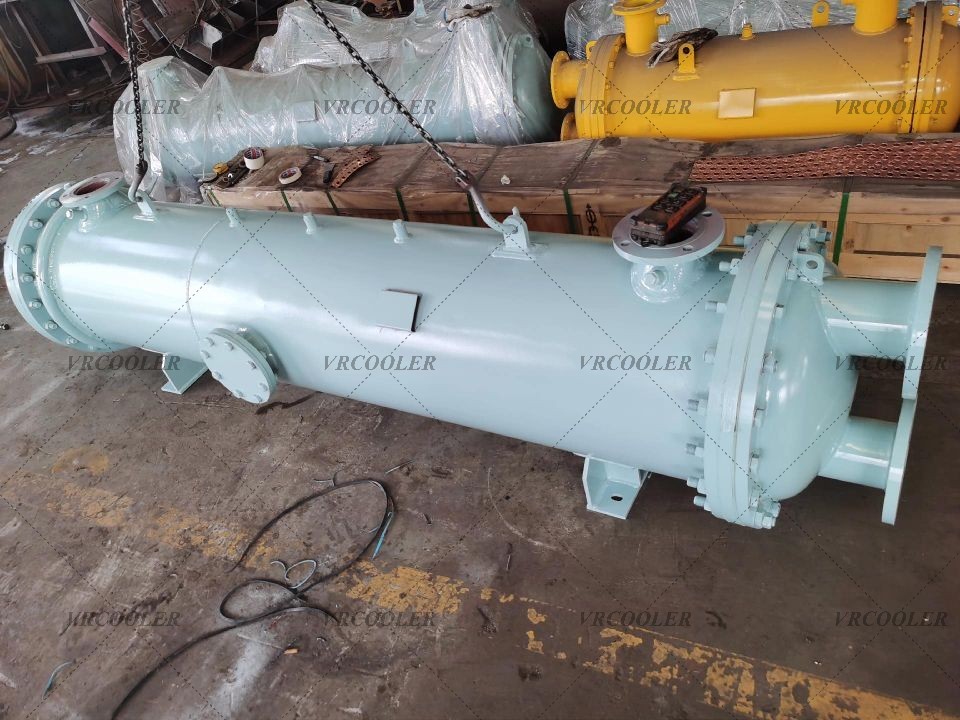
The evaporator side of the system is equally important because condenser performance must match the total refrigeration load. In this case, the evaporating temperature is 2°C, while the chilled water enters at 12°C and leaves at 7°C. The superheat degree is 5°C, and the fouling factor is 0.000016 m²·K/W. These conditions indicate a typical chilled water duty where stable evaporator operation and reliable condenser heat rejection must work together. If the condenser cannot reject heat efficiently, the whole refrigeration cycle becomes less stable. Compressor power rises, system efficiency drops, and the chilled water side may struggle to maintain the desired outlet temperature.
A well-designed marine atmospheric condenser improves more than heat transfer alone. It also supports lower operating stress on the compressor, better system reliability, and easier long-term maintenance. On board a ship, downtime is costly and inconvenient, so the condenser should be designed for dependable service rather than only minimum first cost. Features such as optimized tube arrangement, proper pass design, effective venting, corrosion-resistant construction, and easy cleaning access all make a real difference in daily operation. When the condenser is used with seawater, these design details become even more critical.
From an engineering perspective, the provided operating data suggest a condenser that must be able to handle two different cooling-water conditions while still maintaining stable refrigeration cycle performance. Fresh water cooling offers relatively cleaner service and a lower fouling factor, while seawater cooling requires more conservative design because of scaling and corrosion risk. This is why marine condenser customization is so important. A standard product may not be enough for real vessel conditions. The condenser should be selected or manufactured based on actual water quality, design temperature, space limitations, allowable pressure drop, and expected maintenance intervals.
For shipowners, shipyards, and marine equipment integrators, a custom marine atmospheric condenser offers a more reliable solution than a generic heat exchanger. It can be designed around the exact refrigeration load, the real cooling-water source, and the service environment of the vessel. Whether the system uses fresh water circulation or direct seawater cooling, the goal remains the same: stable condensing performance, efficient refrigeration operation, and long service life in a demanding marine atmosphere.
In modern marine cooling systems, efficiency, durability, and corrosion resistance are all essential. A marine atmospheric condenser designed around actual operating temperatures, subcooling requirements, and fouling conditions provides stronger long-term value than an off-the-shelf unit chosen only by size. With the right thermal design and proper materials, it can support reliable chilled water production, reduce operating risk, and keep marine refrigeration systems performing smoothly even under harsh offshore and shipboard conditions.
Reference Design Conditions
Condenser design condition: condensing temperature 40°C.
Fresh water cooling: inlet 30°C, outlet 35°C, subcooling 5°C, fouling factor 0.000043 m²·K/W.
Sea water cooling: inlet 32°C, outlet 36°C, subcooling 4°C, fouling factor 0.000086 m²·K/W.
Evaporator design condition: evaporating temperature 2°C.
Chilled water: inlet 12°C, outlet 7°C, superheat 5°C, fouling factor 0.000016 m²·K/W.
