
Project Mission Supporting Long Voyage Self Sufficiency
The client required a high-reliability evaporator for installation in a marine freshwater generator system onboard a commercial vessel. Freshwater production at sea is critical for crew living, equipment cleaning, and operational needs.
Designed for continuous operation during long-distance voyages.
Adapted to compact engine room layout with limited installation space.
Integrated with ship waste heat recovery systems to improve energy efficiency.
Engineered to withstand vibration, humidity, and saline air exposure.
The solution needed to balance evaporation efficiency, mechanical durability, and long-term corrosion resistance in harsh maritime environments.
Low Pressure Evaporation Mechanism Enabling Energy Efficiency
The evaporator operates under vacuum conditions to lower the boiling point of seawater, significantly reducing energy consumption.
Heating medium such as engine jacket water or low-pressure steam flows inside the tube bundle.
Seawater is distributed evenly across the shell side.
Heat transfers through tube walls, causing seawater to evaporate at reduced temperature.
Generated vapor rises and is directed toward a condenser section where it becomes distilled water.
By reducing the boiling temperature, the system utilizes low-grade waste heat effectively, minimizing additional fuel consumption.
Internal Structure Designed for Stable Vapor Generation
The structural configuration of the shell and tube evaporator plays a critical role in performance stability.
Tube bundles arranged to maximize heat transfer surface area.
Corrosion-resistant tube materials selected for continuous seawater exposure.
Vacuum-tight shell construction to maintain stable low-pressure environment.
Integrated demister pads to prevent salt droplets from carrying over into condensate.
Proper brine discharge design to control salinity concentration and reduce scaling.
This internal layout ensures steady vapor generation while protecting water purity and mechanical integrity.
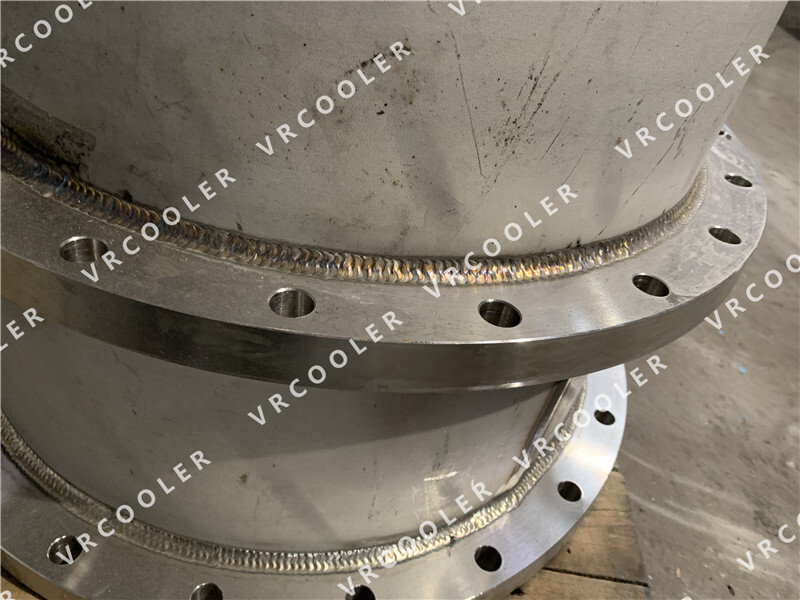
Controlled Manufacturing Ensuring Sealing and Strength
The production phase followed strict fabrication and inspection procedures to guarantee reliability.
Precision drilling of tube sheets to ensure accurate tube alignment.
Controlled tube expansion or welding to prevent micro-leakage.
Full welding inspection of shell joints and nozzle connections.
Hydrostatic pressure testing to verify structural strength.
Vacuum holding tests to confirm sealing performance under operating conditions.
These quality control measures directly affect the evaporator’s operational safety and service life onboard.
Operational Advantages Under Real Marine Conditions
Shell and tube evaporators provide practical advantages in shipboard freshwater generation systems.
Ability to operate efficiently under fluctuating engine load conditions.
Mechanical robustness against ship vibration and motion.
Straightforward maintenance access for cleaning and inspection.
Replaceable tube bundle option for long-term lifecycle management.
Strong adaptability to different vessel sizes and freshwater capacity requirements.
These benefits make shell and tube evaporators a preferred choice for both commercial ships and offshore platforms.
