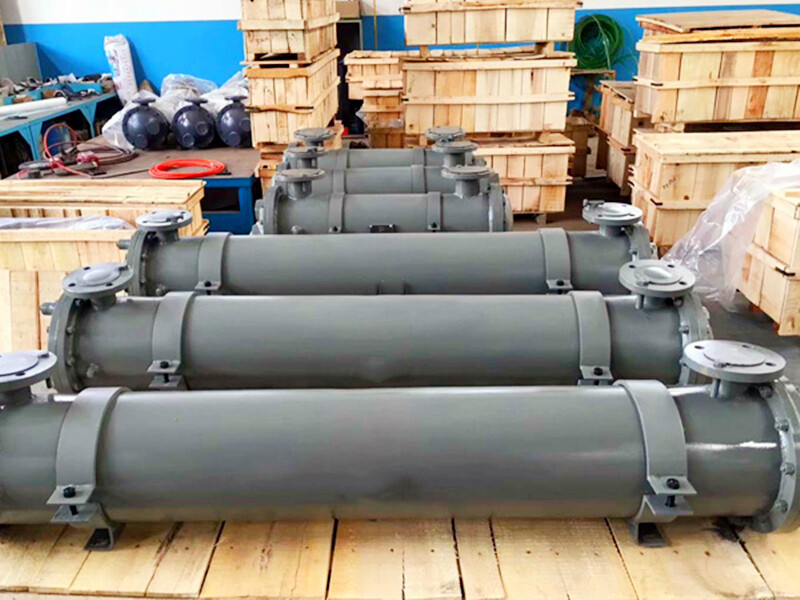
A shell and tube evaporator used for cooling only cold water in a chiller unit is a key component that plays a crucial role in the refrigeration process.
Shell: The shell is a cylindrical vessel that houses the tube bundle. It is typically made of steel or other durable materials that can withstand the pressure and temperature conditions within the evaporator. The shell provides a containment structure for the refrigerant and the water being cooled.
Tube Bundle: Consists of a large number of small-diameter tubes arranged in a specific pattern within the shell. These tubes are usually made of copper or copper alloys due to their excellent heat transfer properties. The refrigerant flows through the tubes, while the cold water to be cooled circulates around the outside of the tubes, within the shell.
Tube Sheets: These are flat plates located at each end of the tube bundle. They are used to hold the tubes in place and provide a seal to prevent the mixing of the refrigerant and water. The tube sheets are carefully designed and fabricated to ensure a proper fit and tight seal to avoid leaks.
Baffles: Baffles are installed inside the shell to direct the flow of water around the tube bundle. They help to increase the turbulence of the water flow, which in turn enhances the heat transfer efficiency between the water and the refrigerant. Baffles also ensure that the water is evenly distributed across the tube bundle, preventing any stagnant areas where heat transfer may be reduced.
Working Principle
Refrigerant Flow: The refrigerant enters the shell and tube evaporator in a liquid state at a relatively low temperature and pressure. It then flows through the tubes of the tube bundle. As the refrigerant passes through the tubes, it absorbs heat from the surrounding cold water, which causes the refrigerant to evaporate and turn into a vapor.
Water Cooling: Cold water is pumped into the shell side of the evaporator and circulates around the outside of the tube bundle. As the water comes into contact with the cold tubes containing the evaporating refrigerant, heat is transferred from the water to the refrigerant. This causes the water temperature to decrease, achieving the desired cooling effect. The cooled water is then circulated back to the chiller unit or to the cooling system where it is needed to provide cooling.
Heat Transfer Process: The heat transfer between the water and the refrigerant occurs through the walls of the tubes. The thin walls of the tubes, along with the large surface area provided by the tube bundle and the enhanced turbulence created by the baffles, facilitate efficient heat transfer. This process continues until the water reaches the desired cooled temperature and the refrigerant has completely evaporated within the tubes.
Advantages
High Heat Transfer Efficiency: The design of the shell and tube evaporator, with its large surface area for heat transfer and the use of baffles to increase water turbulence, results in high heat transfer efficiency. This allows for rapid cooling of the water, enabling the chiller unit to provide effective cooling for various applications.
Compact Design: Despite its relatively complex internal structure, the shell and tube evaporator can be designed to be relatively compact, making it suitable for installation in limited space environments. This is especially beneficial for chiller units that need to be installed in small mechanical rooms or other confined spaces.
Reliable and Durable: The construction of the shell and tube evaporator using robust materials such as steel and copper alloys, along with careful fabrication and assembly techniques, ensures its reliability and durability. It can withstand the high pressures and temperature differentials associated with the refrigeration process, providing long-term service with minimal maintenance requirements.
Versatility: Shell and tube evaporators can be customized to meet different cooling requirements by varying the number of tubes, the tube diameter, the shell diameter, and other design parameters. This makes them suitable for a wide range of chiller unit applications, from small-scale air conditioning systems to large industrial cooling processes.