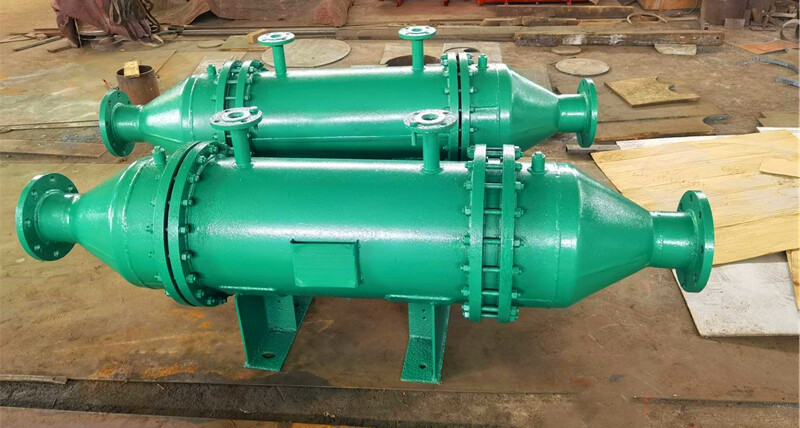
Shell Tube Type Intercooler for Oxygen Compressor
Structure and Working Principle
Basic Structure: It mainly consists of a shell, tube bundle, baffles, head covers, and connecting pipes. The tube bundle is composed of multiple heat exchange tubes fixed between two tube plates, and the baffles are used to support the heat exchange tubes and guide the flow of the cooling medium.
Working Principle: In the shell tube type intercooler, the compressed oxygen gas flows through the tubes (tube side), and the cooling medium, usually water, flows outside the tubes in the shell (shell side). Heat exchange occurs through the tube walls, with the heat of the high - temperature oxygen gas being transferred to the cooling medium, thus reducing the temperature of the oxygen gas.
Design Features
Sealing Design: A double - seal design is adopted to prevent oxygen leakage, and flange and welding processes must strictly follow high - pressure gas pipeline standards, such as ASME B31.3.
Flow Path Design: The gas in the shell - side flow path depends on the special baffle to make the air flow vertically across the tube bundle and move forward in a tortuous way, which can increase the heat exchange area and improve the heat exchange efficiency.
Heat Exchange Tube Form: There are various forms of heat exchange tubes, such as smooth tubes and finned tubes. Smooth tubes are mainly of the fixed - tube - sheet, floating - head, U - tube, and packing - box types specified in GB151. Finned tubes are suitable for occasions where strict pressure loss control is required, and the intercooler is required to be small in size, compact in structure, and high in heat exchange efficiency.
Role and Significance
Controlling Oxygen Temperature: Oxygen will be significantly heated during the compression process, and the intercooler can reduce the oxygen temperature to near the ambient temperature, usually below 40°C, to prevent problems such as pipeline material aging, seal failure, and even combustion caused by high temperatures.
Improving Oxygen Purity: During the cooling process, part of the moisture or impurities may condense and precipitate due to the temperature drop, which can be discharged through the separation device, thereby improving the oxygen purity.
Adapting to Subsequent Processes: The cooled oxygen is more likely to be liquefied and stored or directly transported to oxygen - using equipment, which is conducive to the smooth progress of subsequent processes.