
A thrust bearing oil cooler is a critical heat exchanger in hydroelectric power stations and large rotating machinery. The thrust bearing carries the axial load of the turbine-generator shaft, so the lubricating oil must remain clean, stable, and within the correct temperature range. If the oil temperature rises too high, viscosity drops, the oil film becomes weaker, and bearing pads may suffer from overheating, wear, or even serious damage.
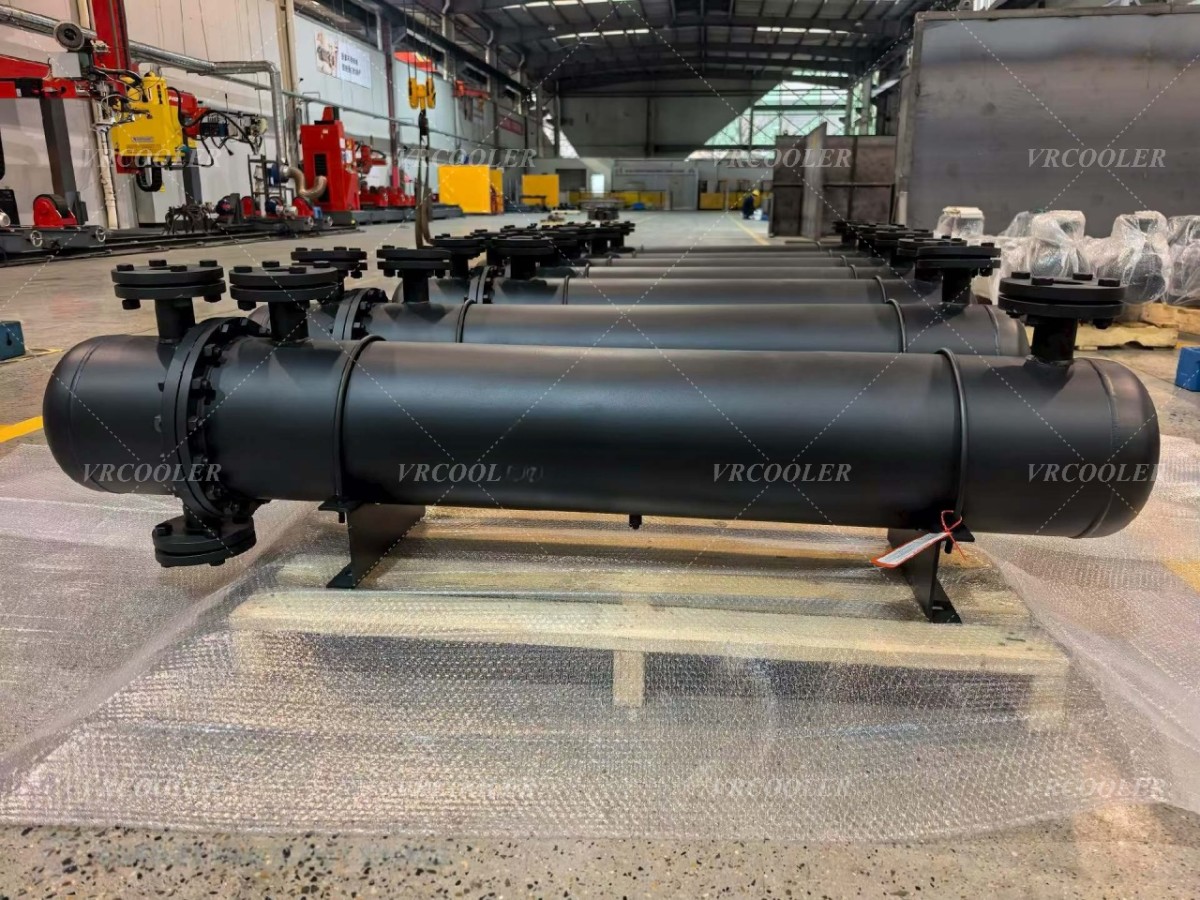
For this application, the cooler is designed as a shell-and-tube heat exchanger. Raw river water flows inside the tubes, while ISO VG turbine or bearing oil flows outside the tubes on the shell side. This arrangement is practical for power station service because the raw water side is easier to inspect, mechanically clean, and maintain. River water normally contains suspended solids, minerals, and biological matter, so keeping it inside the tubes helps reduce maintenance difficulty and protects the lubricating oil circuit from contamination.
The tube bundle uses 70/30 copper-nickel alloy tubes, which are suitable for cooling-water service where corrosion resistance and long operating life are required. The specified tube internal diameter is about 12 mm, with approximately 152 tubes and a tube length of around 2168 mm. This gives the cooler a compact but effective heat-transfer surface for removing heat from the bearing oil. The shell or body is made from mild steel, which is commonly used on the oil side when the medium is non-corrosive lubricating oil.
In this operating case, the cooling water enters the tubes at 25°C with a working pressure of 3.5 bar and a flow rate of not less than 172 L/min. The lubricating oil enters the shell side at about 75°C, with an oil working pressure of 9 bar and a flow rate of 11 L/min. The purpose of the cooler is to bring the oil temperature down close to the required outlet condition before the oil returns to the thrust bearing lubrication system. In final design, the actual oil outlet temperature should be confirmed by thermal calculation because the outlet oil temperature normally depends on water inlet temperature, heat load, fouling margin, flow arrangement, and allowable pressure drop.
One important design feature is the water-inside-tube and oil-outside-tube layout. Raw river water is more likely to cause scaling or fouling than clean closed-loop water, so the tube side can be cleaned by brushing, flushing, or chemical cleaning depending on site conditions. The oil side, being cleaner and more viscous, benefits from the larger shell-side flow area and stable heat-transfer contact around the tube bundle.
For hydroelectric power stations, reliability is usually more important than making the cooler as small as possible. A thrust bearing oil cooler should be designed with sufficient heat-transfer area, proper tube material, strong tube-to-tube-sheet joints, and suitable pressure testing before delivery. The cooler must also be easy to install, drain, vent, and maintain during scheduled shutdowns. Poor cooler performance can lead to high bearing-oil temperature alarms, unstable oil viscosity, higher bearing-pad temperature, and increased maintenance risk.
A well-designed shell-and-tube thrust bearing oil cooler provides stable oil temperature control, protects the thrust bearing, and supports safe long-term turbine operation. With copper-nickel tubes, a mild-steel shell, and a maintainable tube-bundle structure, this type of cooler is a dependable solution for hydro turbine bearing lubrication systems using raw river water as the cooling medium.
