
From Engineering Drawings to Final Assembly
The project began with detailed thermal design and mechanical verification based on the client’s process data.
Precise heat transfer calculations defined the required plate surface area.
Mechanical strength analysis ensured shell integrity under operating pressure.
Nozzle orientation and structural dimensions were adapted to site layout.
Production scheduling and quality checkpoints were established in advance.
During fabrication, welding procedures were strictly monitored, and dimensional tolerances were carefully controlled. Final hydrostatic pressure testing and visual inspections confirmed compliance before shipment.
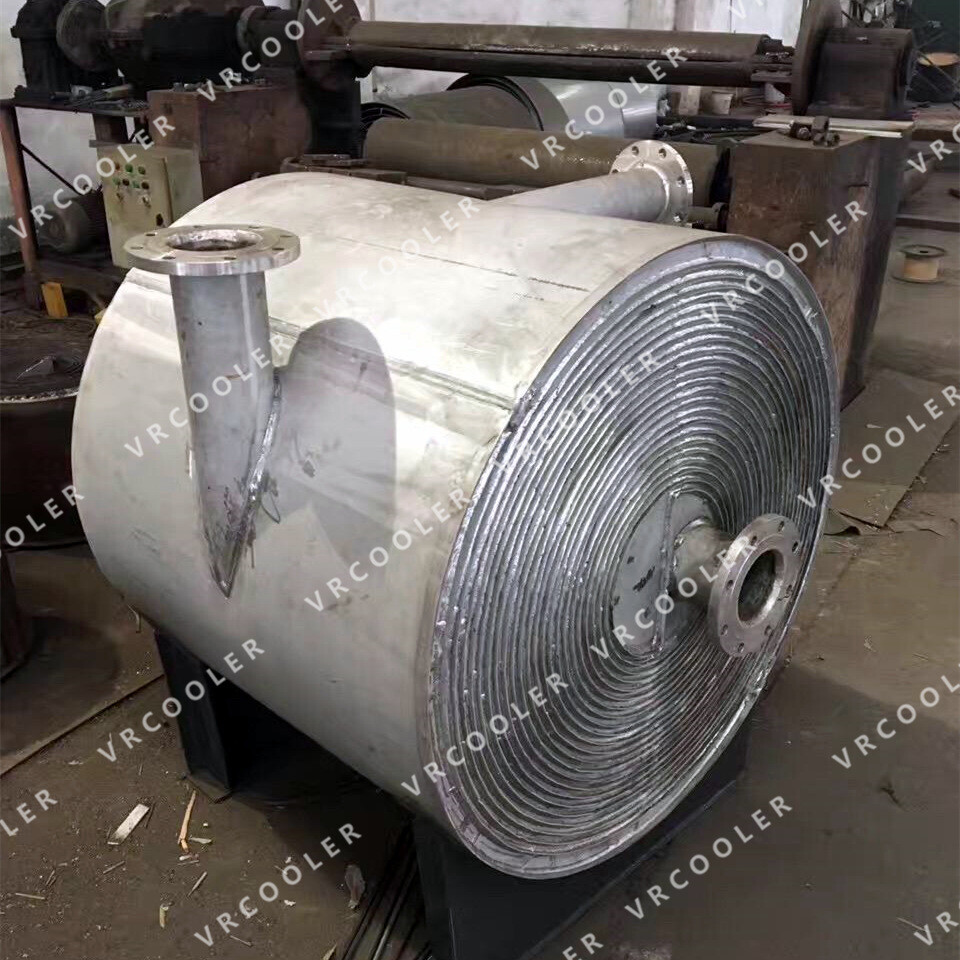
Hybrid Construction Combining Plate Core and Pressure Shell
The plate and shell heat exchanger integrates a fully welded plate pack inside a cylindrical pressure shell.
The internal plate bundle replaces traditional tube bundles.
Corrugated plates create narrow, high-turbulence flow channels.
The outer shell absorbs pressure loads and protects the internal core.
Compact geometry reduces equipment footprint compared to conventional designs.
This structural combination balances thermal efficiency with mechanical reliability.
Heat Transfer Dynamics Within Corrugated Flow Channels
The most distinctive feature of this structure lies in its heat transfer mechanism. Unlike straight tubes, the corrugated plates generate intense turbulence even at relatively low flow velocities.
Fluids are forced to change direction repeatedly within narrow channels.
Turbulence reduces thermal boundary layers and enhances heat transfer coefficients.
Larger effective surface area per unit volume increases performance density.
Counter-current flow arrangement maximizes temperature difference utilization.
This mechanism enables higher thermal efficiency compared to many traditional shell and tube configurations.
Performance Advantages in Demanding Process Conditions
The plate and shell configuration offers several practical benefits for industrial operation:
Superior heat transfer efficiency allows smaller exchanger size.
Fully welded structure eliminates gasket aging risks.
Enhanced resistance to high pressure and temperature fluctuations.
Stable performance under variable process loads.
These advantages make the unit suitable for petrochemical, energy, gas processing, and heat recovery applications.
Manufacturing Discipline Ensuring Long-Term Reliability
The production of plate and shell heat exchangers requires advanced welding expertise and precision control.
Automated or semi-automated welding processes ensure consistent seam quality.
Non-destructive testing verifies structural integrity.
Strict alignment control prevents internal stress concentration.
Pressure testing confirms mechanical safety before delivery.
Such disciplined manufacturing practices directly influence operational lifespan and reliability.
Strategic Value for Future System Upgrades
Beyond immediate thermal performance, this exchanger design supports long-term system flexibility.
Compact size simplifies installation in space-limited facilities.
High efficiency contributes to overall energy savings.
Reduced maintenance frequency lowers lifecycle costs.
Customizable materials allow adaptation to evolving process requirements.
The successful completion of this project demonstrates not only production capability but also advanced engineering expertise in delivering efficient and durable plate and shell heat exchanger solutions.
