
Compressed air systems used in marine and offshore environments often face two major challenges: high discharge air temperature and corrosive cooling conditions. When compressed air leaves the compressor, it normally carries a large amount of heat. If this heat is not removed efficiently, the system may suffer from reduced air quality, higher moisture load, unstable equipment performance, and increased stress on downstream components.
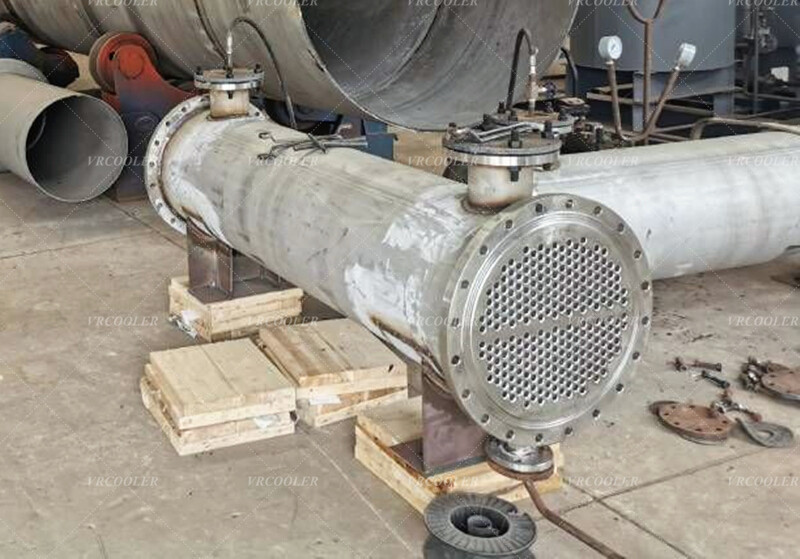
For this application, a seawater-cooled shell and tube heat exchanger is a reliable solution. It uses seawater as the cooling medium and compressed air as the process fluid, allowing heat to be transferred through the tube wall while keeping the two fluids completely separated. This design is especially suitable for vessels, offshore platforms, coastal facilities, and other installations where seawater is readily available but corrosion resistance is critical.
In this design, the shell side is arranged for seawater service with one pass, a maximum working pressure of 110 psig, and a design temperature of 300°F. The shell inlet and outlet connections are 1.5 inch NPT. Because seawater is highly corrosive, the shell, tube sheets, baffles, and tubes are specified in Titanium Grade 1 or Grade 2. Titanium provides excellent resistance to chloride corrosion, seawater erosion, and long-term marine fouling conditions, making it a strong choice for harsh seawater cooling systems.
The tube side is designed for compressed air service, also with one pass, 110 psig design pressure, and 300°F design temperature. The air-side inlet and outlet connections are 2.5 inch NPT. Compressed air flows through 80 titanium tubes with 3/8 inch tube diameter, 23 gauge wall thickness, and 48 inch tube length. This tube arrangement provides a compact heat transfer surface while maintaining a practical flow path for air cooling.
The heat exchanger uses a 0.4531 inch tube pitch, titanium baffles with 1.5 inch spacing, and a 20% baffle cut. This internal structure helps guide seawater flow across the tube bundle, improving turbulence and heat transfer efficiency. At the same time, the one-pass configuration keeps the design simple, reduces pressure drop, and makes the unit easier to install and maintain.
For marine compressed air cooling, material compatibility is one of the most important design considerations. Titanium Grade 1 is commonly selected when excellent corrosion resistance and good formability are required. Titanium Grade 2 offers higher mechanical strength while still maintaining outstanding seawater resistance. The final choice depends on operating pressure, fabrication requirements, cost target, and project specification.
The head material is specified as cast iron. Since the head is normally connected to the compressed air side, it should be evaluated based on air quality, condensate risk, coating requirements, and maintenance conditions. In humid compressed air service, proper drainage and internal protection are important because moisture may form during cooling. The gasket material should also be selected according to seawater exposure, compressed air temperature, pressure, and sealing surface design.
This type of tubular heat exchanger is commonly used after compressors as an aftercooler, where it reduces compressed air temperature before the air enters dryers, receivers, pneumatic equipment, or process systems. By lowering the compressed air temperature, the heat exchanger helps condense moisture, improve air treatment efficiency, protect downstream equipment, and stabilize system operation.
Compared with air-cooled aftercoolers, a seawater-cooled shell and tube heat exchanger offers a more compact structure and stable cooling performance, especially where ambient air temperature is high or installation space is limited. Compared with ordinary stainless steel construction, titanium offers much better long-term reliability in direct seawater service, especially in marine and offshore conditions where chloride corrosion can quickly damage unsuitable materials.
Based on the drawing, the unit is compact, with an overall length of approximately 52.5 inches and a horizontal cylindrical shell arrangement. This makes it suitable for installation in tight machinery spaces, compressor rooms, marine engine rooms, and skid-mounted compressed air packages. The use of NPT connections also supports straightforward piping connection for compact industrial and marine systems.
Vrcooler can customize titanium shell and tube heat exchangers according to actual compressed air flow rate, inlet and outlet air temperature, seawater temperature, seawater flow rate, pressure drop limits, fouling allowance, installation space, connection type, and material requirements. For seawater-cooled compressed air systems, proper thermal design and material selection are essential for safe operation, easy maintenance, and long service life.
A well-designed seawater-cooled titanium shell and tube heat exchanger provides dependable compressed air cooling in corrosive marine environments. With titanium wetted parts, compact tube bundle construction, and practical service access, it is a strong choice for marine compressors, offshore pneumatic systems, shipboard air systems, coastal industrial plants, and other applications where compressed air must be cooled using seawater.
