
In gas and LPG processing plants, treated gas must often be cooled to a precise outlet temperature before it enters downstream equipment, storage, separation, compression, or pipeline systems. This final cooling step is usually handled by a treated gas trim cooler. Although the temperature reduction may look small, the service condition can be demanding because the gas side often operates at high pressure and requires stable, reliable heat transfer.
For this project, Vrcooler supplied a U-type tube bundle for a treated gas trim cooler. The exchanger is designed with gas on the shell side and cooling water on the tube side. According to the case data, the treated gas enters the shell side at 120.5°F, or about 49.2°C, and leaves at 115°F, or about 46°C. The cooling water enters the tube side at 93°F, or about 33.8°C, and leaves at 115°F, or about 46°C. This duty is a typical trim cooling application, where the main purpose is not deep cooling but accurate final temperature control.
One important feature of this case is the high gas-side pressure. The shell side operating pressure is 1035 psig, equal to approximately 7.13 MPa, while the design pressure is 1200 psig, or about 8.27 MPa. This means the tube bundle must be manufactured with strict attention to mechanical strength, tube-to-tubesheet sealing, dimensional accuracy, and pressure integrity. In gas processing service, leakage between the gas side and water side is not acceptable, because it can affect plant safety, process stability, and equipment reliability.
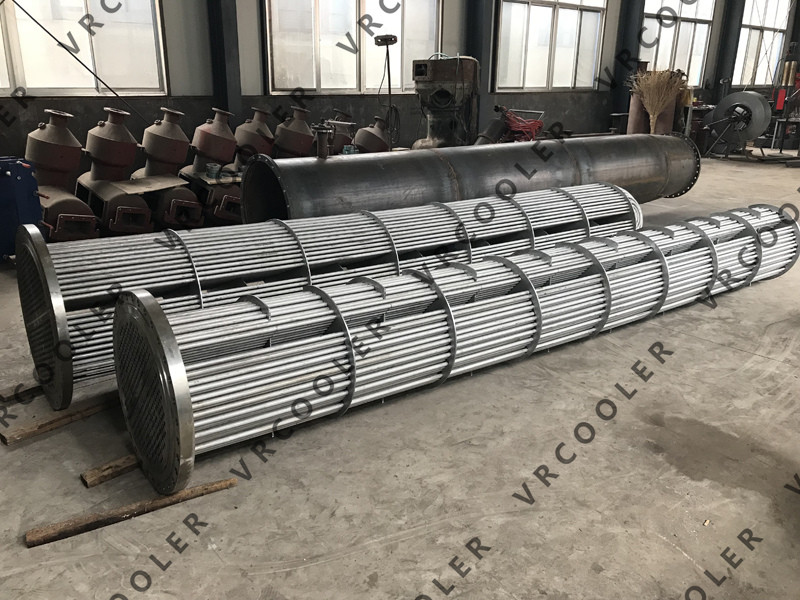
The tube side is designed for cooling water service, with an operating pressure of 50 psig and a design pressure of 150 psig. The hydrostatic test pressure is 1560 psig on the shell side and 195 psig on the tube side, confirming that the bundle and pressure parts are designed with proper safety margin. For this type of heat exchanger, hydrostatic testing is a critical step before delivery because it verifies the strength of the tube bundle, tubesheet joint, and overall assembly.
The bundle uses 328 tubes made from SA179 material. SA179 seamless carbon steel tubes are commonly used for heat exchanger and condenser service where good thermal conductivity, pressure resistance, and economical performance are required. The tube size is 3/4 inch outside diameter with 0.083 inch wall thickness and 141.732 inch length, equivalent to 19.05 × 2.1 × 3600 mm. This tube specification provides a practical balance between heat transfer area, mechanical strength, water-side velocity, and cleanability.
The tube-to-tubesheet joint is designed with welding and expansion. This combined joint method improves sealing reliability and mechanical holding strength. Tube expansion provides tight contact between the tube and tubesheet hole, while welding gives an additional sealing barrier. For high-pressure gas cooler service, this construction is especially important because it helps reduce the risk of leakage, vibration-related loosening, and long-term joint failure.
The U-type tube bundle design also offers advantages for thermal expansion. In shell and tube heat exchangers, the shell side and tube side may operate at different temperatures, and the metal parts expand at different rates. A U-tube bundle can absorb thermal expansion more naturally than a rigid straight-tube fixed design. This makes it suitable for services where pressure, temperature difference, and continuous operation must be considered together.
In a treated gas trim cooler, stable performance is essential. If the tube bundle is undersized, fouled, or poorly manufactured, the treated gas outlet temperature may rise above the required limit. This can affect downstream process control and may increase the load on compressors, separators, dryers, or storage systems. A well-designed tube bundle helps maintain the required outlet gas temperature while keeping pressure drop within the allowable range.
For gas and LPG processing plants, material selection and manufacturing quality are just as important as thermal design. The bundle must be suitable for the gas composition, cooling water quality, operating pressure, design temperature, corrosion allowance, and inspection requirements. Depending on the project, tube materials can also be upgraded to stainless steel, duplex stainless steel, Cu-Ni, or other alloys if corrosion resistance is required.
Vrcooler can customize shell and tube heat exchanger tube bundles for treated gas coolers, LPG plant coolers, compressor intercoolers, gas aftercoolers, condensers, and other process cooling equipment. Each tube bundle can be designed according to process data, pressure rating, tube material, tube size, tubesheet joint type, inspection requirement, and applicable project standards. For demanding gas processing applications, a reliable tube bundle is not only a replacement part, but also a key component for safe and stable plant operation.