
Shell and Tube Heat Exchangers for Condensers and Evaporators in Air Conditioning Systems
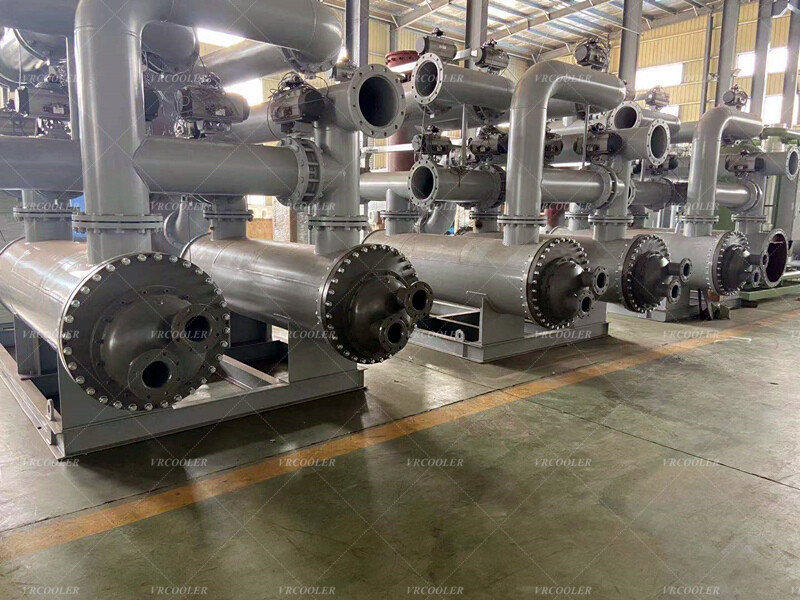
Shell and tube heat exchangers have a wide and important application in condensers and evaporators in air conditioning systems.
In the refrigeration cycle of air conditioning, the role of the condenser is to cool the high-temperature and high-pressure gaseous refrigerant and condense it into liquid state. When a shell and tube heat exchanger is used as a condenser, the gaseous refrigerant flows inside the tubes while the cooling medium (usually water or air) flows in the shell course, taking the heat away from the refrigerant through heat exchange.
The evaporator, on the other hand, is responsible for evaporating the low-temperature, low-pressure liquid refrigerant into a gaseous state, thereby absorbing heat from the room to achieve the cooling effect. In the shell and tube evaporator, the liquid refrigerant evaporates outside the tube, and the refrigerant carrier (e.g. cold water) flows inside the tube to achieve heat transfer.
Shell and tube condensers and evaporators are widely used in large commercial central air-conditioning systems. Due to the large cooling capacity of the system, the shell and tube heat exchanger can provide sufficient heat transfer area and efficient heat transfer performance to meet the cooling needs of large spaces.
In some industrial refrigeration and air conditioning systems, shell and tube heat exchangers are ideal for condensers and evaporators because of their ability to withstand higher pressures and larger temperature differences.
Shell and tube heat exchangers play a key role in the condenser and evaporator of air-conditioning systems, providing an important guarantee for achieving comfortable indoor environments and efficient cooling.
