
A Hybrid Concept Bridging Plate Efficiency and Shell Strength
Plate shell heat exchangers represent an innovative design that combines two different heat exchanger technologies into one compact unit.
Traditional plate heat exchangers are known for their excellent heat transfer efficiency but may have limitations when operating under high pressure conditions. Shell and tube heat exchangers, on the other hand, offer strong pressure resistance but usually require larger equipment sizes.
The plate shell heat exchanger integrates the advantages of both designs:
High heat transfer efficiency from corrugated plates
Strong pressure containment from the outer shell
Compact equipment footprint for limited installation spaces
This hybrid concept allows the equipment to perform effectively in demanding industrial environments.
Corrugated Plate Packs Creating Powerful Heat Transfer Surfaces
At the center of the plate shell heat exchanger is the welded plate pack, which acts as the main heat transfer element.
The plates are carefully formed with corrugated patterns that create narrow flow channels between adjacent plates.
These corrugations provide several advantages:
Increased turbulence within the fluid flow
Larger effective heat transfer surface area
Improved thermal performance compared to flat plates
Because of these characteristics, plate shell exchangers can achieve very high heat transfer coefficients even in compact equipment designs.
This makes them particularly useful in applications where space efficiency is important.
Shell Enclosure Protecting the Plate Core Structure
While the internal plate pack handles the heat transfer process, the outer shell provides mechanical protection and pressure containment.
The shell structure offers several important benefits:
Protection for the internal plate pack from external forces
Capability to withstand higher operating pressures
Improved mechanical stability for long-term operation
The shell also allows the exchanger to operate safely under industrial conditions where pressure fluctuations and temperature changes may occur.
By enclosing the plate pack within a robust shell body, the equipment achieves both efficiency and durability.
Precision Welding Technology Ensuring Structural Integrity
One of the key manufacturing challenges in plate shell heat exchangers is the welding of the plate pack.
Each plate must be precisely welded to form sealed channels for fluid flow. These welds must be strong enough to withstand pressure while maintaining leak-free separation between the two process fluids.
The manufacturing process typically involves:
Accurate plate forming and alignment
Automated welding techniques for consistent quality
Careful inspection of all weld joints
Precision welding ensures that the plate pack functions as a reliable heat transfer core inside the exchanger.
Customized Engineering for Industrial Process Requirements
Every industrial process has different operating parameters such as temperature levels, flow rates, and pressure conditions.
Therefore, plate shell heat exchangers are often designed as customized equipment.
Engineering considerations may include:
Selection of appropriate plate materials
Determination of plate channel spacing
Design of shell dimensions and nozzle connections
By tailoring the design to the specific application, the heat exchanger can achieve optimal performance within the client’s process system.
Delivering a Compact and Reliable Heat Transfer Solution
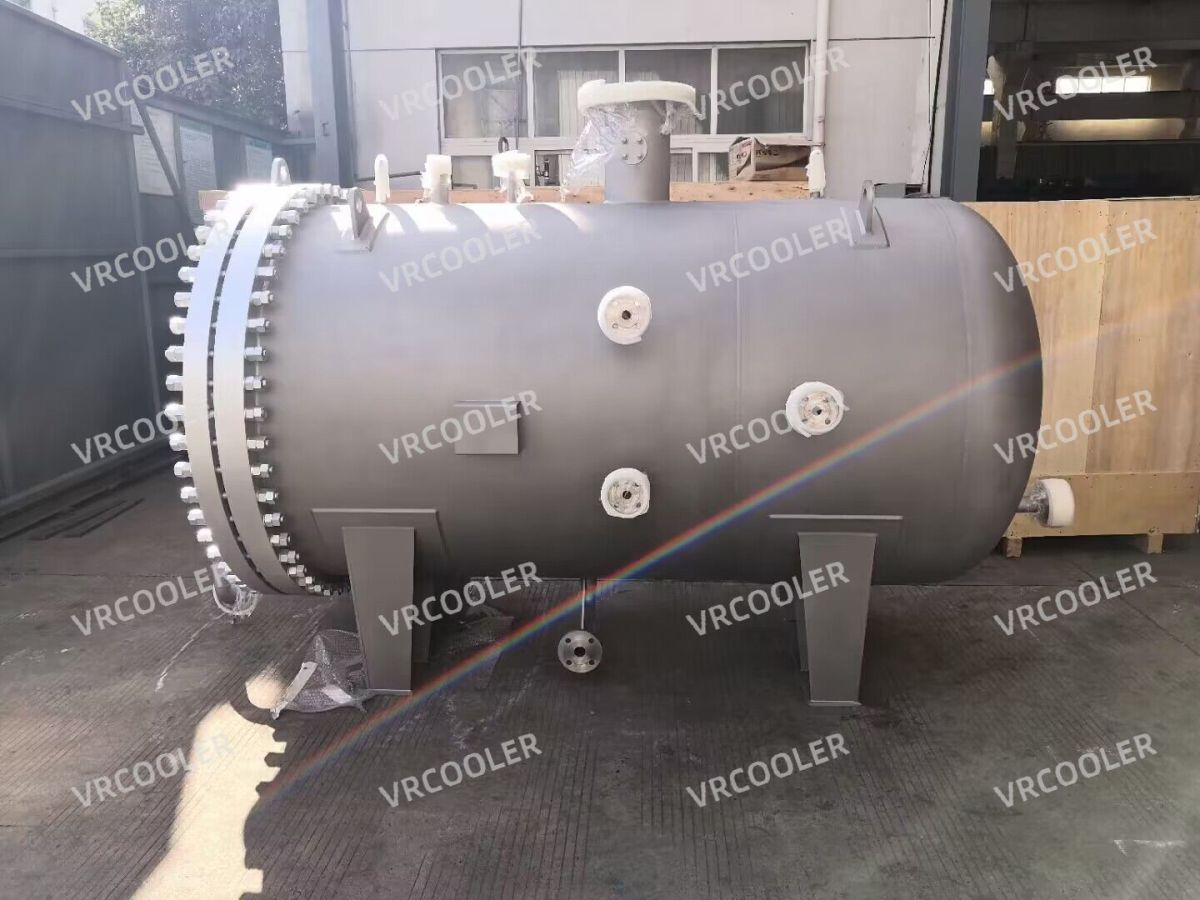
For this project, the completed plate shell heat exchanger was manufactured according to the client’s technical requirements and operational conditions.
After final inspection and testing, the equipment was prepared for delivery and installation.
Once integrated into the industrial system, the exchanger will help provide:
Efficient heat transfer performance
Reduced equipment footprint
Stable long-term operation
This project demonstrates how plate shell heat exchanger technology offers a powerful solution for modern industrial heat transfer applications, combining compact design with reliable structural strength.
