
Thermal Transition Engineering From Gas to Cryogenic Liquid
Hydrogen liquefaction is fundamentally a temperature transformation process. Gaseous hydrogen must be cooled in controlled stages to prevent thermal shock, material stress, and efficiency loss. Shell and tube heat exchangers enable this transformation through indirect and carefully regulated heat transfer.
Hydrogen flows through either the tube side or shell side depending on contamination control strategy.
Cooling media such as liquid nitrogen or mixed refrigerants absorb heat progressively.
Multi-stage exchanger arrangements gradually reduce temperature before final expansion.
Counter-current flow design maximizes temperature difference and heat transfer efficiency.
This staged cooling approach ensures safe conversion from ambient gas to ultra-low temperature liquid hydrogen.
Strategic Positioning Within Liquefaction Process Architecture
In a hydrogen liquefaction train, shell and tube heat exchangers are installed at multiple technical nodes, each serving a specific thermal function.
Compressor interstage coolers remove heat generated during hydrogen compression.
Pre-cooling exchangers lower hydrogen temperature before cryogenic expansion cycles.
Refrigerant condensers and evaporators maintain closed-loop refrigeration systems.
Cold energy recovery units exchange heat between outgoing and incoming streams.
Their modular design allows engineers to configure exchangers in series or parallel, adapting to plant capacity ranging from pilot-scale to large industrial production.
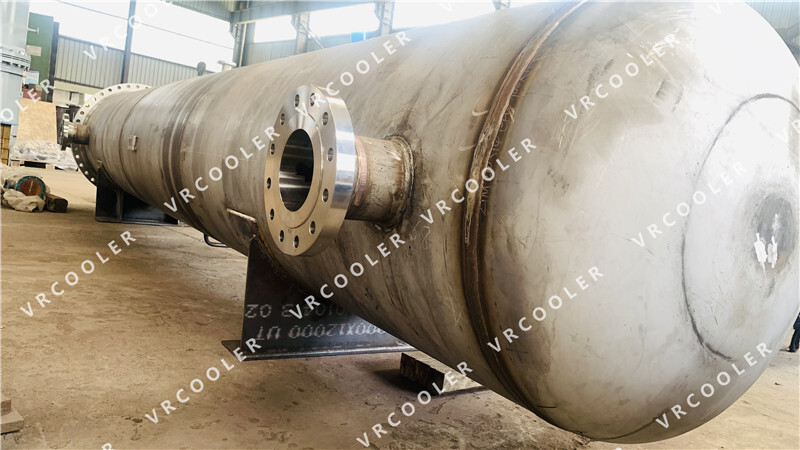
Mechanical Strength Under Cryogenic Stress
Hydrogen liquefaction combines high pressure, extremely low temperature, and continuous operation — a combination that challenges material integrity. Shell and tube heat exchangers are engineered to withstand these extremes.
Thick cylindrical shells resist internal hydrogen pressure.
Cryogenic-grade stainless steel or special alloys prevent brittle fracture at low temperature.
Floating head or expansion joint designs accommodate thermal contraction.
Welded construction minimizes potential leakage points in high-purity hydrogen environments.
This structural resilience ensures long-term safety even under repeated cooling and warming cycles.
Energy Optimization Strengthening Decarbonization Goals
Hydrogen liquefaction is energy-intensive, making thermal efficiency a decisive factor in project sustainability. Shell and tube heat exchangers enhance overall process efficiency through advanced thermal integration.
Recuperative heat exchange reduces refrigeration energy demand.
Efficient interstage cooling decreases compressor power consumption.
Optimized flow distribution minimizes exergy loss.
Heat recovery integration improves total plant energy balance.
By reducing specific energy consumption per kilogram of liquefied hydrogen, shell and tube heat exchangers directly contribute to lowering carbon intensity in hydrogen supply chains.
In hydrogen liquefaction systems, shell and tube heat exchangers are far more than conventional heat transfer equipment. They are engineered thermal control platforms that enable safe cryogenic operation, enhance energy efficiency, and strengthen the technological foundation of global decarbonization initiatives.
