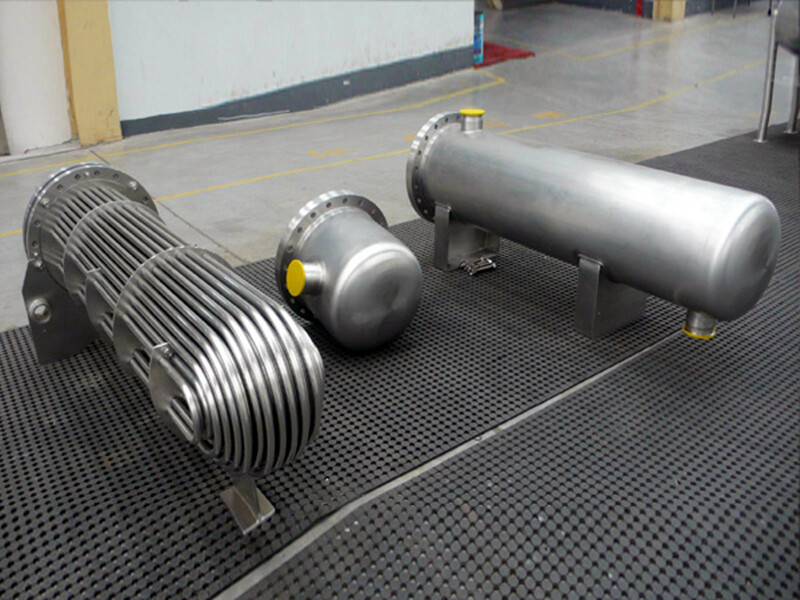
A shell and tube evaporator is primarily designed for cooling purposes, but with some modifications and when used in a different context within a heat pump system, it can also be utilized for heating.
Standard Operation - Cooling
In a typical refrigeration or air conditioning system, the shell and tube evaporator functions to cool a fluid (usually water or a secondary refrigerant). The refrigerant enters the tubes in a liquid state at a low temperature and pressure. As it passes through the tubes, it absorbs heat from the warmer fluid circulating around the outside of the tubes within the shell. This causes the refrigerant to evaporate, and in the process, it cools the surrounding fluid, which is then used for cooling applications such as air conditioning or process cooling.
Use in Heat Pump Systems for Heating
Reversing the Cycle: In a heat pump system, the refrigeration cycle can be reversed. Instead of the evaporator being used to cool a fluid, it can be used to absorb heat from a low-temperature source, such as outdoor air, ground water, or the ground itself. In this case, the shell and tube evaporator acts as the evaporator during the heating mode of the heat pump.
Heat Absorption from the Environment: When the heat pump is in heating mode, the refrigerant in the shell and tube evaporator absorbs heat from the external source. The fluid circulating around the outside of the tubes is now at a lower temperature than the refrigerant, and heat is transferred from the fluid to the refrigerant, causing it to evaporate.
Compression and Condensation: The evaporated refrigerant is then compressed to a higher temperature and pressure by the compressor. It then flows to the condenser, where it releases the absorbed heat to the indoor air or water, providing heating for the space or the heating system.
Considerations for Heating Applications
Temperature Range: The shell and tube evaporator needs to be designed or selected to handle the specific temperature range of the heat source during heating mode. For example, if it is absorbing heat from outdoor air in cold weather, it must be able to operate effectively at lower temperatures without issues such as frosting or reduced heat transfer efficiency.
Refrigerant Selection: The choice of refrigerant is crucial for efficient heating operation. Some refrigerants are better suited for lower temperature heat absorption and have better thermodynamic properties for heat pump applications in heating mode.
System Design and Control: The overall heat pump system design, including the sizing of the shell and tube evaporator, the compressor, and other components, needs to be optimized for heating performance. Additionally, proper control systems are required to ensure smooth transitions between cooling and heating modes and to maintain efficient operation throughout the year.
Insulation and Frost Protection: In heating mode, especially when absorbing heat from outdoor air, measures may be needed to prevent frost formation on the evaporator surface. This could involve the use of defrost cycles or enhanced insulation to minimize heat loss and maintain the performance of the evaporator.