
Can a Steam-Liquid Separator Handle High-pressure Steam?
Steam-Liquid Separators can absolutely handle high-pressure steam—in fact, they are critical components in high-pressure steam systems (e.g., power generation, industrial boilers, and heavy manufacturing) where moisture in steam poses severe risks (e.g., turbine blade erosion, reduced heat transfer efficiency, or equipment damage). However, their ability to handle high pressure depends on two key factors: specialized design considerations and material selection tailored to high-pressure operating conditions.
What Defines "High-Pressure Steam" for Separators?
In industrial contexts, "high-pressure steam" generally refers to steam with pressures exceeding 10 bar (145 psi). For extreme applications (e.g., power plants), pressures can reach 100–300 bar (1,450–4,350 psi) or higher, paired with temperatures above 300°C. Separators for these systems are not "one-size-fits-all"—they are engineered to withstand these harsh conditions while maintaining separation efficiency.
Key Design Adaptations for High-Pressure Steam Separators
To handle high pressure, separators incorporate specific design features that address the unique challenges of high-pressure steam (e.g., higher fluid velocity, increased stress on components, and the risk of re-entraining water droplets):
a. Robust Structural Design
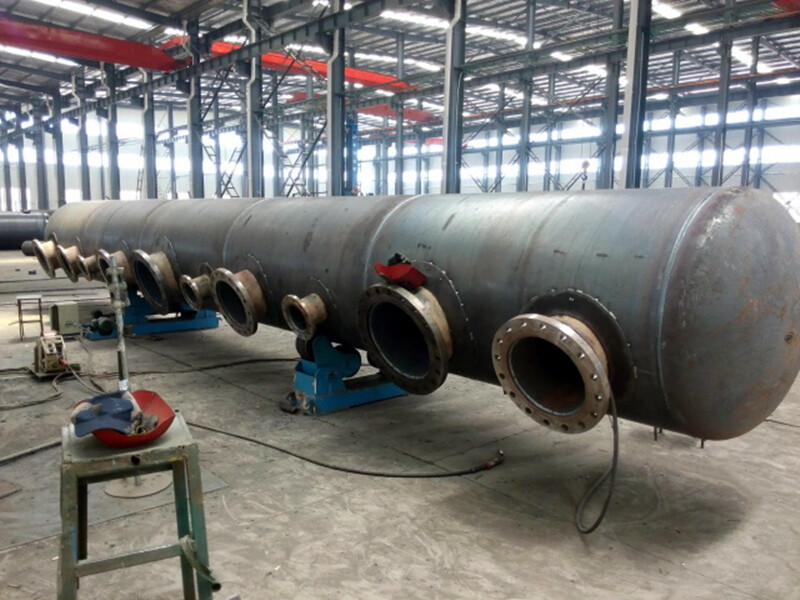
Thicker Wall Construction: High-pressure separators use cylindrical or spherical chambers with significantly thicker walls (compared to low-pressure models) to resist the outward force of high-pressure steam. The wall thickness is calculated using standards like the ASME Boiler and Pressure Vessel Code (BPVC) or EN 13445 to ensure structural integrity.
Reinforced Nozzles: Inlet/outlet nozzles (where steam enters and exits) are thicker and often welded with full-penetration joints to prevent leakage or failure at connection points—high pressure can create concentrated stress at these areas.
Minimized Dead Zones: High-pressure steam flows at very high velocities (up to 10 m/s or more). Separators are designed with smooth internal surfaces and no "dead zones" (stagnant areas) to avoid pressure buildup, turbulence, or re-entrainment of separated water.
b. Optimized Separation Mechanisms for High Velocity
High-pressure steam’s high velocity can disrupt gravity-based separation (the slowest mechanism). Instead, high-pressure separators rely on centrifugal force and inertial impaction—mechanisms that are effective even at high flow rates:
Cyclonic (Centrifugal) Separators: The most common type for high pressure. They use a tangential inlet to create a powerful swirling (cyclonic) flow inside the chamber. Dense water droplets are thrown outward by centrifugal force (amplified at high pressure) toward the separator’s inner wall, where they drain downward into a sump. Dry steam, being less dense, stays in the center of the vortex and exits through a top-mounted outlet.
Example: In power plants, cyclonic separators are installed upstream of steam turbines to remove moisture—even small droplets (10–50 μm) can erode turbine blades over time, so centrifugal separation ensures >99.9% dry steam.
Baffle-Type Separators (High-Pressure Variants): For moderately high pressures (10–50 bar), baffles are designed with steeper angles and thicker materials to withstand pressure. They use inertial impaction: high-velocity wet steam hits the baffles, water droplets collide and coalesce, then drain via gravity (aided by the separator’s vertical orientation to counteract high flow).
c. Pressure-Tight Seals and Drainage
Leak-Proof Sumps: The sump (where separated water collects) is sealed with gaskets or welded joints rated for high pressure to prevent steam leakage.
High-Pressure Steam Traps: A critical accessory—high-pressure separators use traps (e.g., float-and-thermostatic traps, or thermodynamic traps) rated for the system’s pressure. These traps automatically drain collected water without releasing steam, ensuring the separator does not accumulate liquid or lose pressure.
Material Selection for High-Pressure Separators
Materials must resist not only high pressure but also corrosion (from steam impurities like oxygen or dissolved solids) and thermal stress (from temperature fluctuations):
Carbon Steel: Used for moderate high-pressure systems (up to ~50 bar, 400°C) where steam is relatively clean (e.g., industrial heating). It is cost-effective and has good tensile strength.
Alloy Steels (e.g., Chromium-Molybdenum Steel): For extreme high-pressure/high-temperature systems (50–300 bar, >400°C), such as power plant boilers. Alloys like 1Cr-0.5Mo or 2.25Cr-1Mo offer superior creep resistance (resistance to deformation under long-term heat and pressure) and corrosion resistance.
Stainless Steel (e.g., 316L): Used in high-pressure systems where steam or water is corrosive (e.g., pharmaceutical, food processing, or chemical industries). It resists oxidation and chemical attack but is
Limitations and Considerations for High-Pressure Use
While high-pressure steam separators are effective, they have constraints that must be addressed:
Pressure Drop: All separators create a small pressure drop (typically 0.1–1 bar) as steam flows through. For high-pressure systems, this drop must be minimized (via optimized nozzle sizing and smooth internal flow paths) to avoid wasting energy.
Sizing: Undersized separators cannot handle high steam flow rates, leading to poor separation or excessive pressure drop. Oversized separators are costly and may cause low steam velocity (risking re-entrainment of water). Separators are sized using manufacturer software or standards (e.g., ISO 13702) based on steam flow rate, pressure, and required dryness fraction.
Maintenance: High-pressure separators require regular inspection (e.g., ultrasonic testing of walls for cracks) and cleaning (to remove scale or debris from baffles/vanes). A blocked drain valve or corroded wall can lead to catastrophic failure under high pressure.
