
Diesel engines are widely used in generator sets, marine power systems, industrial plants, oilfield equipment, mining sites, and backup power stations. During operation, only part of the fuel energy is converted into mechanical or electrical power. A large amount of heat is still discharged through the exhaust gas, jacket water, lubricating oil, and charge air cooling system. If this waste heat is released directly to the atmosphere, valuable energy is lost.
Waste heat recovery from a diesel engine is an effective way to improve total energy efficiency. By using a shell and tube heat exchanger, heat from the diesel engine can be recovered and transferred to water, glycol, thermal oil, or another process fluid. The recovered heat can then be used for domestic hot water, space heating, fuel preheating, process water heating, boiler feedwater preheating, absorption cooling, or other industrial heating applications.
A shell and tube heat exchanger is suitable for diesel engine waste heat recovery because it has strong pressure resistance, reliable mechanical structure, and good adaptability to high-temperature working conditions. The hot medium usually flows through one side of the exchanger, while the cold medium flows through the other side. Heat is transferred through the tube wall without mixing the two fluids. Depending on the project, the recovered heat may come from engine exhaust gas, jacket water, lubricating oil, or a combination of several heat sources.
For exhaust gas heat recovery, the shell and tube exchanger is installed in the engine exhaust line. Hot exhaust gas passes through the shell side or tube side, while water or thermal oil absorbs heat from the other side. Since diesel exhaust may contain soot, oil mist, sulfur compounds, and acidic condensate, the heat exchanger must be designed with suitable material, cleaning access, drainage, and low-pressure-drop gas passages. Stainless steel tubes are often used for exhaust gas applications, especially when condensation or corrosive conditions may occur.
For jacket water heat recovery, the exchanger operates under lower temperature but more stable conditions. Engine jacket water normally contains a significant amount of recoverable heat and can be used to produce hot water efficiently. A shell and tube heat exchanger for jacket water recovery is usually more compact than an exhaust gas heat exchanger and can provide stable heating output during continuous engine operation.
The design of a diesel engine waste heat recovery exchanger must consider engine power, exhaust gas flow rate, exhaust inlet and outlet temperature, jacket water temperature, target hot water temperature, flow rate, allowable pressure drop, fuel type, operating hours, installation space, and cleaning requirements. If the heat exchanger is oversized, cost and space may increase. If it is undersized, the recovered heat will be limited and the system may not meet the heating demand.
Pressure drop is especially important in exhaust gas recovery. The heat exchanger must not create excessive back pressure on the diesel engine. High exhaust back pressure can reduce engine performance, increase fuel consumption, and affect safe operation. Therefore, the tube arrangement, gas channel size, baffle design, and exchanger length must be carefully selected.
Vrcoolertech can customize shell and tube heat exchangers for diesel engine waste heat recovery systems. The unit can be designed for exhaust gas-to-water, exhaust gas-to-thermal oil, jacket water-to-water, lube oil-to-water, or combined heat recovery applications. Materials, tube size, shell diameter, connection type, removable bundle design, cleaning ports, insulation, drain structure, and mounting supports can be customized according to the engine and site requirements.
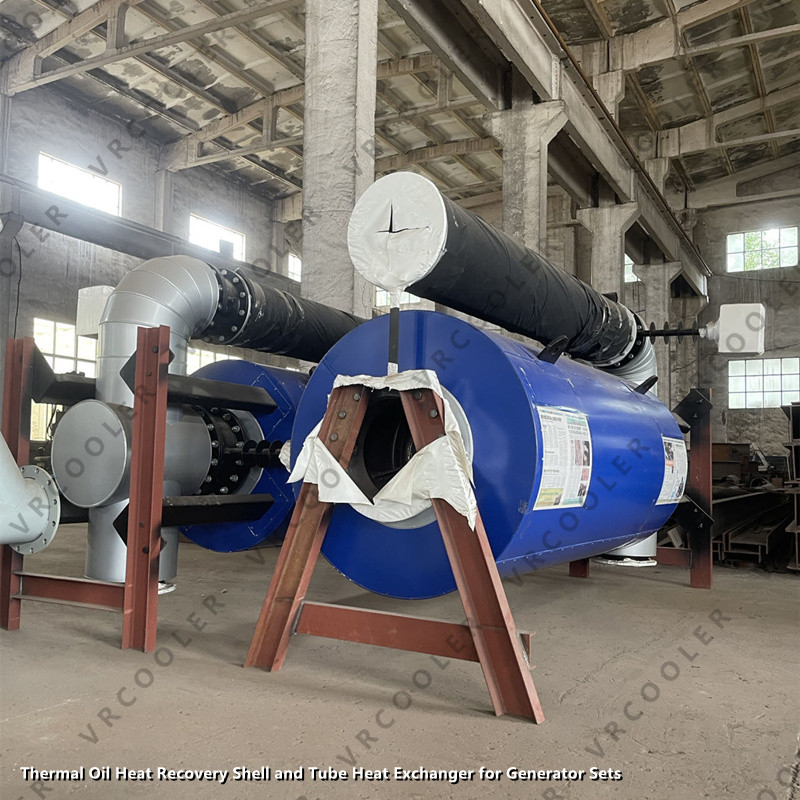
Case Study: Shell and Tube Heat Exchanger for Diesel Generator Waste Heat Recovery
A customer operated a diesel generator set for continuous power supply at an industrial site. During operation, the engine exhaust gas left the system at high temperature, while the plant also required hot water for process use and daily operation. The customer wanted to recover part of the exhaust heat instead of consuming additional fuel for water heating.
Vrcoolertech reviewed the diesel engine power, exhaust gas temperature, exhaust flow rate, required water flow rate, target outlet water temperature, available installation space, and allowable exhaust back pressure. Based on these conditions, a customized shell and tube exhaust gas heat recovery exchanger was designed.
The heat exchanger used a robust shell and tube structure with suitable heat transfer area and low-resistance gas flow channels. The exhaust gas side was designed with cleaning access to allow soot removal during maintenance. The water side was arranged to absorb heat efficiently and provide stable hot water output. Flanged connections and mounting supports were customized to match the customer’s exhaust piping and skid layout.
After installation, the hot exhaust gas passed through the heat exchanger before entering the stack. Cold water entered the exchanger and absorbed heat from the exhaust gas, producing usable hot water for the plant. The system reduced wasted exhaust energy and lowered the customer’s additional heating fuel consumption.
This case shows that a shell and tube heat exchanger is a practical solution for diesel engine waste heat recovery. With correct thermal design, low exhaust pressure drop, corrosion-resistant material, and convenient cleaning structure, the exchanger can help engine users improve energy efficiency and reduce operating costs.