
Understanding the Client’s Process Conditions and Design Requirements
Every refinery system operates under unique process conditions, which means that standard equipment designs are often not sufficient.
Before starting the design work, our engineering team conducted a detailed analysis of the client’s operating parameters.
The key factors considered included:
Crude oil flow rate and physical properties
Temperature range for both hot and cold streams
Operating pressure conditions
Installation environment and available space
Understanding these parameters allowed engineers to develop a heat exchanger design that perfectly matched the client’s processing system.
Engineering Design Tailored for Efficient Process Integration
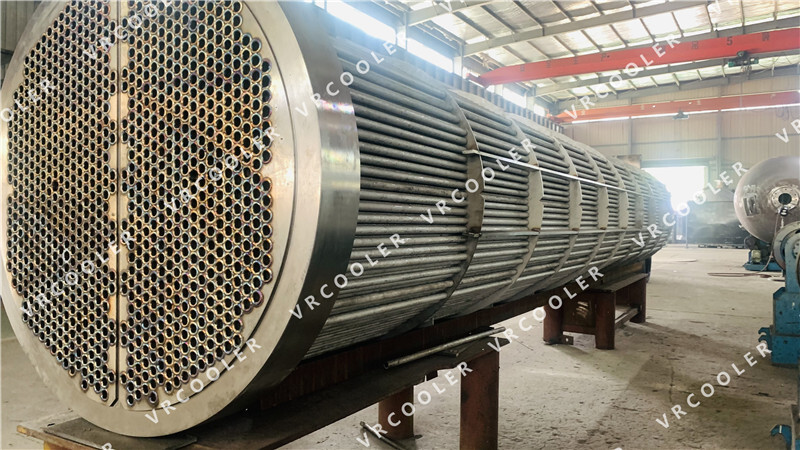
Based on the collected technical data, a customized shell and tube heat exchanger configuration was developed.
The engineering design included several optimized elements:
Appropriate shell diameter and exchanger length
Optimized tube bundle layout
Correct nozzle positions for process piping
The goal of this design phase was to ensure that the exchanger could be seamlessly integrated into the refinery process system while delivering high thermal efficiency.
Careful engineering also helps prevent issues such as excessive pressure drop or uneven heat distribution.
Precision Fabrication from Raw Material to Complete Assembly
Once the design was finalized, the project entered the manufacturing stage.
Production began with careful preparation of raw materials followed by a series of fabrication steps:
Tube sheet machining with precise drilling patterns
Tube bundle assembly and expansion into tube sheets
Shell rolling and welding to form the pressure vessel body
Installation of internal support plates and baffles
Each component was manufactured according to engineering drawings to guarantee structural accuracy and performance reliability.
Strict Quality Control Throughout the Production Process
Quality assurance was maintained at every stage of production.
The inspection process included:
Verification of raw material certifications
Dimensional inspection during fabrication
Welding quality inspection
Alignment checks during assembly
These measures ensure that the final product meets both technical specifications and industrial safety standards.
Maintaining strict quality control helps prevent operational problems once the exchanger is installed in the refinery system.
Delivering a Reliable Solution for Refinery Heat Recovery
The customized crude preheat exchanger was successfully delivered according to the project schedule.
Once installed in the refinery unit, the equipment will support:
Efficient heat recovery from hot process streams
Gradual preheating of crude oil before distillation
Improved refinery energy utilization
This project demonstrates the value of customized engineering and precise manufacturing in providing reliable heat exchanger solutions for complex refinery operations.
