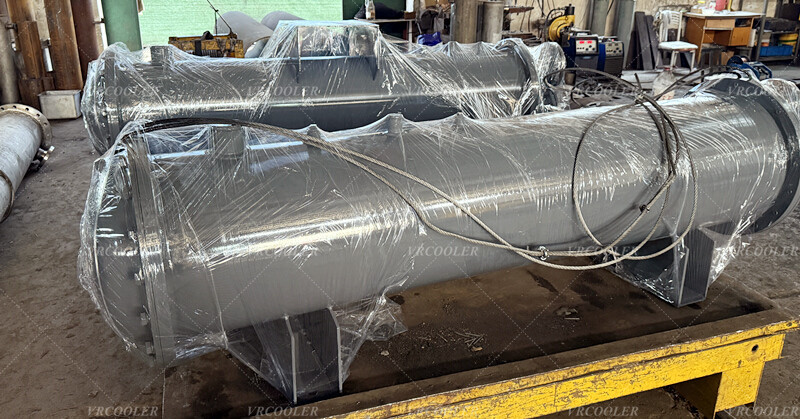
Different Types Of Shell And Tube Heat Exchangers
1. Fixed Tube Sheet Heat Exchanger
Design: Tubes are fixed at both ends to the tube sheets, which are welded to the shell.
Advantages: Simple design, easy to clean and maintain.
Disadvantages: Limited thermal expansion capability; not suitable for applications with high temperature differentials.
2. U-Tube Heat Exchanger
Design: The tubes are bent into a U-shape, allowing for thermal expansion of the tubes while keeping them fixed at one end.
Advantages: Accommodates differential expansion and is easier to clean than fixed tube sheet designs.
Disadvantages: More complex construction and potentially higher pressure drops.
3. Floating Head Heat Exchanger
Design: One end of the tube bundle is free to move, allowing for expansion and contraction.
Advantages: Excellent for high-temperature applications; easy to clean and maintain.
Disadvantages: More complex and may require more space compared to fixed designs.
4. Double Tube Heat Exchanger
Design: Consists of one tube inside another. One fluid flows through the inner tube, and the other flows in the annulus between the two tubes.
Advantages: Simple design and easy to maintain.
Disadvantages: Limited heat transfer area; not suitable for large-scale applications.
5. Multi-Channel Heat Exchanger
Design: Uses multiple parallel channels for fluid flow, enhancing heat transfer efficiency.
Advantages: High efficiency and compact design.
Disadvantages: More complex and potentially higher manufacturing costs.
6. Plate and Frame Heat Exchanger
Design: Although not a traditional shell and tube design, it uses plates to create multiple channels for fluid flow.
Advantages: High heat transfer efficiency and compact size.
Disadvantages: More susceptible to fouling and requires regular maintenance.