
In many power plants, marine systems, oil and gas facilities, chemical plants and heavy industrial sites, closed cooling water is one of the most important utility systems. It protects engines, generators, compressors, turbines, hydraulic systems, lube oil systems and auxiliary equipment from overheating. A duplex closed cooling-water exchanger is designed for this kind of continuous-duty service, where stable cooling performance and reliable standby operation are required.
A duplex design normally means that two heat exchangers are installed in parallel, often with a changeover valve or isolation valves. One unit can operate while the other remains on standby, or both units can operate together when higher cooling capacity is required. This arrangement is very useful for plants that cannot stop production for routine cleaning or inspection. When one exchanger needs maintenance, the operator can isolate it and keep the cooling-water circuit running through the other side.
For closed cooling-water service, shell and tube construction is still one of the most practical and durable solutions. The cooling medium can be fresh water, treated water, glycol solution or seawater, depending on the site conditions. The hot closed-loop water usually flows through one side of the exchanger, while the cooling water or secondary circuit removes the heat on the other side. Compared with compact heat exchangers, shell and tube units offer stronger mechanical construction, easier inspection, better tolerance to fouling and more flexible material selection.
BEM and BEU configurations are commonly selected according to the process conditions and maintenance requirements. A BEM type heat exchanger uses a fixed tubesheet design with a bonnet or channel head. It is suitable for clean fluids and stable operating conditions where thermal expansion is not severe. The structure is simple, robust and cost-effective, making it a common choice for many closed cooling-water systems.
A BEU type heat exchanger uses a U-tube bundle, which allows the tube bundle to expand freely under temperature changes. This design is especially useful when there is a noticeable temperature difference between the two fluids. The U-tube bundle can usually be removed from the shell for inspection and cleaning on the outside of the tubes. For industrial plants where long-term maintainability is important, BEU construction can provide a good balance between reliability and service access.
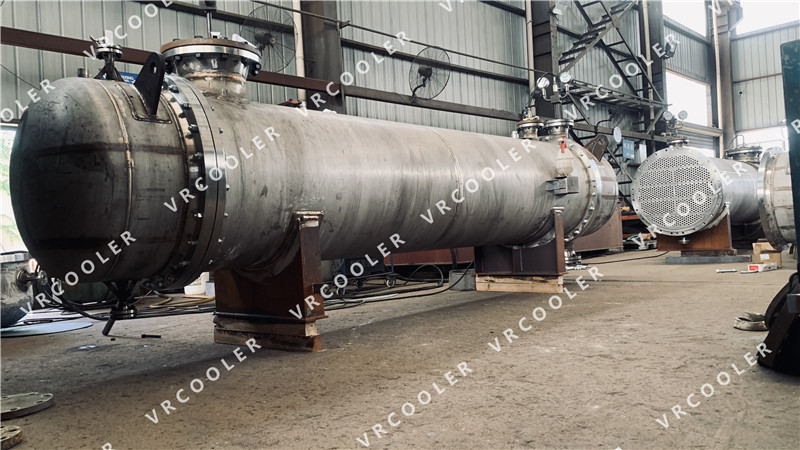
In addition to standard BEM and BEU designs, removable bundle construction is often preferred for demanding closed cooling-water applications. A removable tube bundle makes maintenance much easier, especially when the cooling water quality is variable or when scaling, sediment or biological fouling may occur. Operators can pull out the bundle, inspect the tubes, clean the tube surfaces and replace damaged parts without replacing the whole exchanger. This greatly reduces downtime and helps extend the working life of the equipment.
Material selection is a key factor in duplex closed cooling-water exchanger design. For fresh water or treated closed-loop water, carbon steel shells with copper alloy, stainless steel or carbon steel tubes may be suitable. For seawater cooling or corrosive service, stainless steel, duplex stainless steel, Cu-Ni 90/10, titanium or other corrosion-resistant materials may be required. Duplex stainless steel is often selected when higher strength and better chloride resistance are needed, especially in marine, offshore and coastal plant applications.
The exchanger must also be designed with proper allowance for fouling, pressure drop, water velocity and thermal expansion. If the water velocity is too low, sediment can settle inside the tubes and reduce heat transfer. If the velocity is too high, erosion may occur, especially in seawater or sandy water service. A well-designed closed cooling-water exchanger should keep the heat transfer performance stable while maintaining acceptable pressure loss for the pump system.
For critical service, Vrcooler can customize the exchanger according to operating temperature, working pressure, heat duty, water flow rate, allowable pressure drop, installation space and maintenance preference. The design can include fixed tubesheet, U-tube, floating head or other removable bundle structures. Nozzle orientation, flange standard, tube material, shell material, baffle spacing, pass arrangement and painting system can all be matched to the project requirements.
A high-quality duplex closed cooling-water exchanger is not just a heat transfer device. It is part of the plant’s reliability system. In generator cooling, compressor cooling, diesel engine cooling, turbine auxiliary cooling and marine machinery cooling, a failure in the cooling-water exchanger can affect the safety and stability of the whole system. This is why strong mechanical design, correct material selection and convenient maintenance access are so important.
Vrcooler supplies custom shell and tube closed cooling-water exchangers for industrial users who need reliable performance under real operating conditions. Whether the project requires a BEM fixed tubesheet unit, a BEU U-tube exchanger or a removable bundle design, the exchanger can be engineered to match the cooling duty, water quality, site layout and maintenance strategy. With suitable design and manufacturing control, the system can provide stable heat removal, reduced downtime and long service life for demanding industrial cooling applications.
