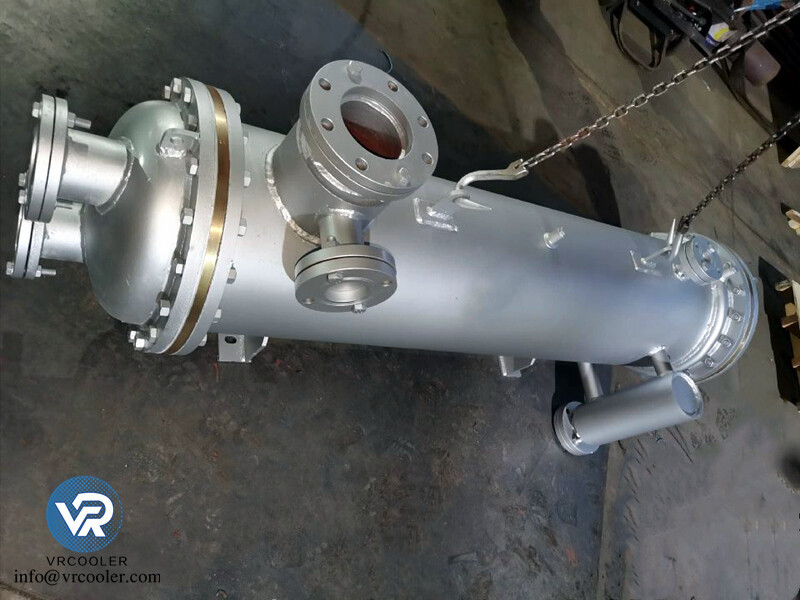
Evaporators for Process Liquids in Chemical Production Processes
Chemical process liquids often exhibit high viscosity, contain impurities, and possess strong corrosive properties. Furthermore, the evaporation process frequently requires high-temperature and high-pressure environments. Shell-and-tube structures are specifically designed to address these challenges:
Resistance to Complex Media: When processing liquids (such as saline solutions or materials containing suspended particles) flow through the shell side, the wide shell-side passages of shell-and-tube evaporators minimize clogging from impurity buildup or crystallization. Additionally, tube bundles can be fabricated from corrosion-resistant materials like 316L stainless steel or titanium alloys based on the medium's corrosivity, preventing equipment corrosion.
Withstanding High Temperatures and Pressures: Chemical evaporation often requires high-pressure steam (or high-temperature thermal oil) as a heat source. The tube bundle and shell of shell-and-tube evaporators can be constructed from thick-walled metals (such as carbon steel or stainless steel), capable of withstanding pressures of 1-3 MPa and temperatures of 200-300°C, meeting the operational requirements of most chemical processes.
Chemical production demands exceptional stability in evaporation rates and vaporization efficiency. Shell-and-tube evaporators achieve both efficiency and controllability through structural design:
Heat transfer efficiency tailored to process needs: Baffles installed in the shell side alter the flow path of the process liquid, extending its residence time in the shell side. Simultaneously, they force the liquid to flow vertically over the tube bundle surface, reducing boundary layer thermal resistance and enhancing heat transfer efficiency. Additionally, the heat transfer area can be flexibly adjusted by increasing the number of tubes or optimizing tube length to match different evaporation capacity requirements (ranging from several tons per hour to hundreds of tons per hour).
Precise Temperature Control:
The heating medium (e.g., steam) flows through the tube side. By regulating steam valves to control flow rate, the tube bundle wall temperature can be precisely managed. This prevents decomposition or coking of process fluids due to localized overheating (e.g., heat-sensitive chemical raw materials), ensuring product quality.
Chemical production demands stringent equipment safety and maintenance accessibility. The shell-and-tube evaporator's structural design aligns perfectly with these requirements:
High Safety Redundancy: Connections between the shell, tube sheets, and tube bundles (e.g., expansion joints, welds) undergo rigorous strength calculations and leak testing to prevent process fluid or heating medium leakage. Additionally, pressure gauges, safety valves, and temperature sensors can be installed separately in the shell and tube sides for real-time monitoring. These systems trigger protective measures immediately upon detecting over-temperature or over-pressure conditions.
Low Maintenance Cost and Ease of Service: Should scaling occur in the tube side (e.g., steam condensate scaling), the tube bundle can be cleaned by disassembling the end cap and employing methods such as high-pressure water flushing or chemical cleaning. If a single tube bundle is damaged (e.g., corrosion perforation), only that specific bundle needs replacement, eliminating the need to scrap the entire unit. This significantly reduces downtime losses and maintenance costs for chemical production lines.