
A Gas Chiller U Tube Bundle is one of those components that does not attract much attention until process stability depends on it. In gas processing service, the bundle is the real heat-transfer core inside the shell and tube exchanger. It is where the hot gas gives up heat, where refrigeration duty is delivered, and where the exchanger either performs reliably day after day or becomes a bottleneck. For plants handling natural gas, wet CO2 streams, and hydrocarbon refrigeration, a well-built U-tube bundle is not just a spare part. It is a process-critical item.
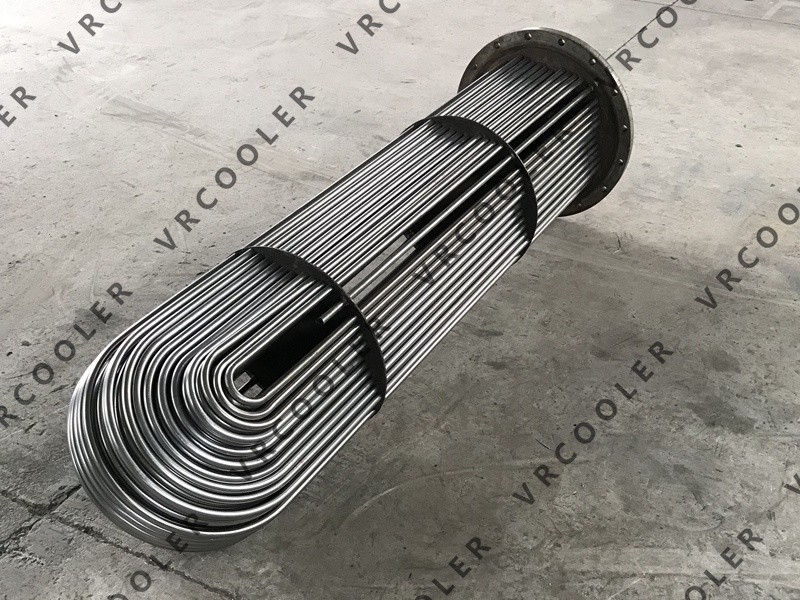
In this case, the exchanger is designed as a BKU type shell and tube gas chiller, built to ASME Section VIII Div.1 with U stamp construction. The duty is substantial: about 1,827,715 BTU/hr. The shell side medium is propane, flowing at 13,304 lb/hr, while the tube side carries natural gas and wet CO2 with EG injection at 207,669 lb/hr. The gas stream enters at 86.67°F and leaves at 70°F, while the propane refrigerant side operates from -29.99°F to -25.94°F. That combination tells you immediately this is a serious low-temperature process cooler, likely tied to gas conditioning, temperature control, or hydrocarbon process chilling where stable outlet temperature matters.
What makes the U-tube bundle especially suitable for this kind of service is its ability to handle thermal expansion in a simple and robust way. In a gas chiller, the shell side and tube side often run at very different temperatures and pressures. A fixed straight-tube bundle can see significant stress if expansion is not handled properly. A U-tube design solves much of that naturally. The tubes are free to expand and contract through their bend geometry, which reduces thermal stress and supports long-term mechanical reliability. In real plant conditions, that is a major advantage.
This design also fits high-pressure gas service well. Here, the tube side design pressure is 1415 psig, while the shell side design pressure is 270 psig/FV. That is a meaningful differential, and it shows why mechanical integrity matters. The tube side is doing the heavy containment work for the process gas, while the propane refrigeration side remains on the shell. For this reason, material selection and fabrication quality are not secondary details. They are central to safe operation.
The material selection on this unit reflects that. The tubes are SA213 TP316L seamless stainless steel, and the tubesheets are SA182 F316L, which is a solid choice for corrosion resistance and low-temperature process duty. Other wetted and structural components combine stainless and carbon steel appropriately, including SA240-316L, SA240-304, and SA516-70N materials where required. This mixed-material construction is common in well-engineered process exchangers because it puts corrosion-resistant alloys where the process demands them and uses strong pressure-vessel carbon steel where it makes structural and economic sense.
Another strength of a gas chiller U-tube bundle is its practicality during maintenance or replacement. In many plants, the shell remains in acceptable condition while the bundle sees wear, fouling, erosion, vibration damage, or corrosion over time. In that situation, replacing the U-tube bundle is often far more economical than replacing the complete exchanger. A correctly manufactured replacement bundle can restore thermal performance, pressure integrity, and operating confidence without major piping changes. For operators trying to reduce downtime, that matters a lot.
This exchanger uses 1 shell pass and 2 tube passes, which is a common arrangement when the engineer wants to balance heat transfer efficiency with pressure drop control. Gas chilling service often requires careful thermal design because outlet temperature directly affects downstream separation, condensation behavior, hydrate control, or compressor performance. A bundle that is dimensionally correct but thermally inaccurate can create real operating issues. That is why bundle replacement work needs to match not only tube count and layout, but also tube OD, wall thickness, bend radius, pitch, pass partitioning, material grade, and bundle length.
For low-temperature gas service, the mechanical details are just as important as the thermal ones. This unit has a minimum design metal temperature of -50°F on both shell and tube sides. It is also specified with 100% radiography, hydrostatic test pressures of 357 psig on the shell side and 1895 psig on the tube side, and a process-oriented construction standard. Those are not cosmetic specifications. They reflect a exchanger built for demanding hydrocarbon duty rather than light industrial service.
In actual operation, a gas chiller U-tube bundle like this may be used in natural gas cooling, hydrocarbon condensation systems, gas dew point control, or process refrigeration loops where propane is used as the cooling medium. The presence of wet CO2 and EG injection suggests a service where moisture handling and low-temperature process control are important. In such applications, the bundle must do more than transfer heat efficiently. It must also resist vibration, withstand pressure, and maintain dependable performance over long run times.
A good Gas Chiller U Tube Bundle is therefore a combination of precise thermal design, correct metallurgy, and disciplined fabrication. When those three come together, the result is a bundle that installs correctly, performs to design duty, and supports stable plant operation. For gas processing companies, EPC contractors, and maintenance teams, that is the difference between a routine turnaround item and a piece of equipment they can trust.