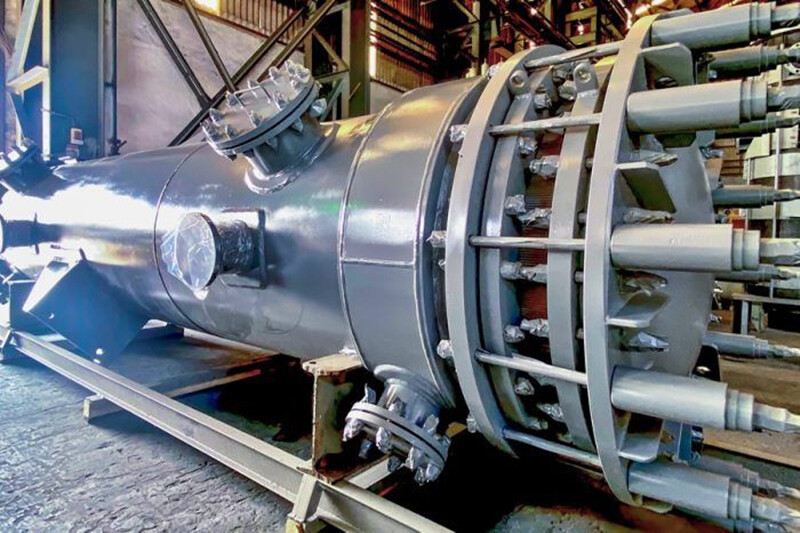
Graphite shell-and-tube heat exchangers are frequently employed in heat exchange during sulfuric acid dilution processes due to their excellent corrosion resistance and thermal conductivity.
Structural Features
Tube bundle material: Typically manufactured from impermeable graphite, such as impregnated graphite, featuring a high thermal conductivity of ≥110 W/(m·K), compressive strength ≥35 MPa, and porosity ≤0.5%. This effectively resists sulfuric acid corrosion while ensuring mechanical strength. Common tube diameter combinations include Φ22/Φ32 mm, Φ25/Φ37 mm, and Φ36/Φ50 mm, accommodating varying flow requirements.
Tube Bundle Arrangement: Two configurations exist—equilateral triangular and square. Equilateral triangular arrangement enhances heat transfer efficiency, with an external heat transfer coefficient 15%-20% higher than square arrangement; square arrangement facilitates mechanical cleaning and is suitable for high-solids content conditions.
Shell Material: Typically steel-lined graphite or all-graphite construction, accommodating design temperatures from -20°C to 200°C to meet temperature variation requirements during sulfuric acid dilution.
Sealing Design: Features dual O-ring seals with a surface roughness of Ra ≤ 3.2 μm. Flange bolt preload complies with HG/T 20592 standards, achieving a leakage rate < 0.01% to prevent sulfuric acid leakage. The floating tube sheet design accommodates thermal expansion of the tube bundle, preventing stress cracking.
Working Principle
During sulfuric acid dilution, concentrated sulfuric acid and dilution water enter the tube side or shell side of the heat exchanger at a predetermined ratio. Cooling media (e.g., water or coolant) flow countercurrently on the opposite side. Graphite's excellent thermal conductivity rapidly transfers the substantial heat generated during acid dilution through its walls to the cooling medium, achieving the desired temperature for the diluted sulfuric acid.
Performance Advantages
Exceptional Corrosion Resistance: Graphite withstands sulfuric acid corrosion, enabling long-term stable operation in highly corrosive environments with extended service life. For instance, Φ22/Φ32 mm graphite tubes maintain stable performance for over 10 years in sulfuric acid dilution applications.
High Heat Transfer Efficiency: Enables substantial heat exchange at minimal temperature differentials. Its base heat transfer coefficient reaches - Liquid heat transfer reaches 500-1200 W/(m²・K), representing a 30%-50% improvement over traditional metal heat exchangers.
Excellent Thermal Stability: Graphite exhibits a low thermal expansion coefficient, maintaining structural integrity during significant temperature fluctuations. It resists deformation and damage, effectively withstanding temperature variations inherent in the sulfuric acid dilution process.