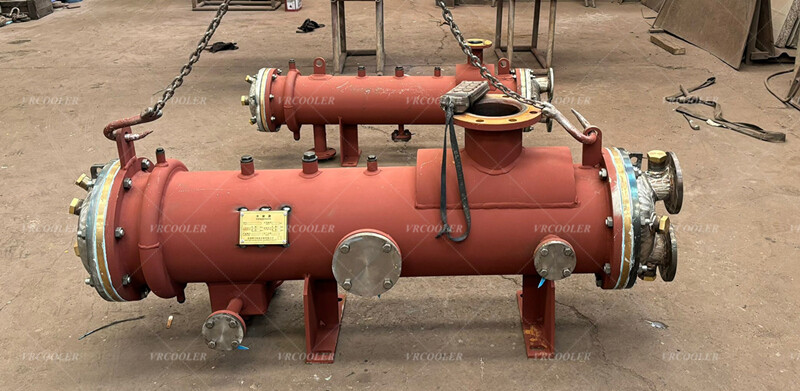
How Does a Shell and Tube Evaporator Work?
Shell and tube evaporator is a type of evaporator commonly used in refrigeration systems, and its working principle is mainly based on the phase change of the refrigerant in the tube heat absorption and heat exchange with the medium in the shell and process.
Refrigerant cycle
Evaporation heat absorption: in the refrigeration system, from the expansion valve outflow of low temperature and low pressure liquid refrigerant into the shell and tube evaporator tube. As the tube space increases and the pressure decreases, the liquid refrigerant begins to boil and evaporate, in the process, the refrigerant absorbs a large amount of heat, from the liquid state gradually into the gas state. This is a phase change process, the absorption of the latent heat of phase change makes the refrigerant temperature inside the tube remain at a relatively low level, creating low temperature conditions for heat exchange.
Gaseous refrigerant discharge: evaporation of the gaseous refrigerant formed in the tube continues to flow, and ultimately from the evaporator outlet outflow, the compressor is sucked into the next link in the refrigeration cycle, such as compression, condensation and other processes, to complete the entire refrigeration cycle.
Heat exchange
Shell medium heating: the medium to be cooled (such as refrigerant, water or other fluids) in the evaporator shell flow. These media usually have a high temperature, and there is a temperature difference with the low-temperature refrigerant in the tube. According to the principle of heat transfer, heat is transferred from the higher temperature shell medium to the lower temperature refrigerant in the tube.
Heat conduction and convection: In the heat transfer process, it is mainly carried out in two ways. On the one hand, the heat is transferred to the tube wall by convection heat transfer between the shell medium and the outer wall of the tube; on the other hand, the heat is transferred from the outer wall to the inner wall of the tube by heat conduction through the tube wall. Then, the inner wall of the tube carries out convective heat transfer with the refrigerant inside the tube to transfer heat to the refrigerant, so that the refrigerant can continue to evaporate and absorb heat, thus realizing the cooling of the shell process medium.
Temperature control
Automatic adjustment: Shell and tube evaporators usually work in conjunction with the control system of the refrigeration system. The temperature sensor in the system will monitor the temperature of the shell and tube medium or the temperature of the refrigerant in the tube and other parameters in real time, and feedback these signals to the controller. The controller automatically adjusts the opening of the expansion valve according to the difference between the set temperature value and the actual measured value, thus controlling the flow of refrigerant into the evaporator. When the shell medium temperature rises, the controller will increase the expansion valve opening so that more refrigerant enters the evaporator to enhance the refrigeration effect; conversely, when the temperature decreases, the expansion valve opening will be reduced and the refrigerant flow will be decreased to keep the temperature within the set range.