
Marine vessels operate under demanding and continuously changing load conditions. Main engines, auxiliary engines, gearboxes, and hydraulic systems generate significant heat, and maintaining stable oil temperatures is essential for reliability, lubrication performance, and equipment lifespan. Shell and tube oil coolers are the industry’s preferred solution for oil cooling on ships due to their durability, corrosion resistance, serviceability, and high thermal efficiency.
Why Shell and Tube Coolers Are Ideal for Marine Vessels
1. High Resistance to Marine Corrosion
Marine environments expose equipment to seawater, salt-laden air, and vibration. Shell and tube coolers can be built using:
Copper-nickel (CuNi) for high seawater corrosion resistance
Titanium for maximum durability in aggressive seawater
Stainless steel for freshwater or closed-loop cooling
These materials ensure long service life with minimal performance degradation.
2. Robust Construction for Heavy-Duty Operation
Ship engines and hydraulic systems operate continuously for thousands of hours. Shell and tube coolers withstand:
High operating pressures
Vibrating machinery foundations
Thermal cycling during start-stop operations
This makes them ideal for main propulsion and auxiliary engine cooling.
3. Easy Maintenance and Tube Cleaning
Marine vessels require equipment that can be serviced quickly. The removable tube bundle allows:
Mechanical brushing
High-pressure water cleaning
Easy descaling
Crew can maintain the cooler onboard without specialized tools.
4. Efficient Heat Transfer with Compact Footprint
Multi-pass tube arrangements, enhanced surface tubes, and turbulence-creating baffles ensure:
High heat transfer performance
Stable oil outlet temperature
Compact size suitable for engine rooms
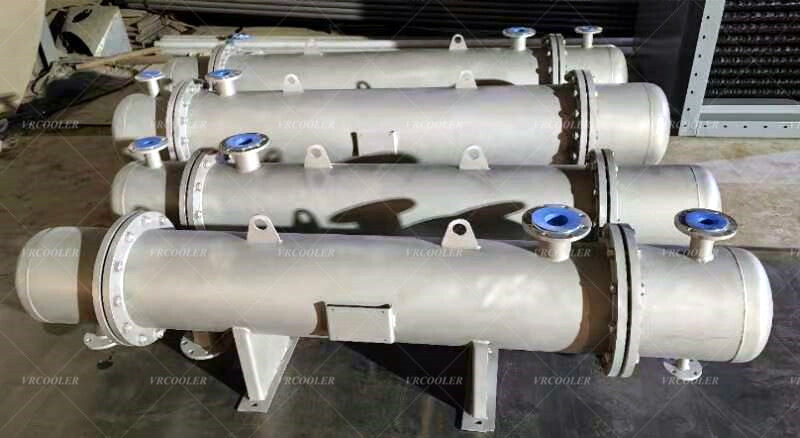
Typical Applications on Marine Vessels
1. Main Engine Lube Oil Cooling
Lube oil must be maintained within a narrow temperature range to ensure viscosity and film strength. Shell and tube coolers:
Keep lube oil temperature stable
Prevent bearing wear
Increase engine reliability
2. Gearbox and Propulsion System Oil Cooling
Marine gearboxes generate substantial heat due to friction and load.
Oil coolers remove excess heat to protect gear teeth and maintain smooth operation.
3. Hydraulic System Oil Cooling
Steering systems, winches, cranes, and deck machinery rely on hydraulic circuits.
Shell and tube coolers prevent overheating during high-load operations.
4. Generator and Auxiliary Engine Cooling
Auxiliary engines run continuously for power generation on board. Oil coolers ensure:
Continuous lubrication
Reduced component wear
Stable electrical power output
5. Thruster Systems and CPP (Controllable Pitch Propeller) Units
These systems operate under fluctuating loads and require consistent oil cooling to maintain responsiveness.
