
Steam-Liquid Separator (also called a steam trap, moisture separator, or steam-water separator) is a critical component in steam systems, designed to remove entrained liquid water from steam. Its core function is to ensure dry steam reaches end-use equipment (e.g., heat exchangers, sterilizers, or turbines), as moisture can reduce heat transfer efficiency, cause corrosion, or damage machinery. The separation process relies on physical principles (inertia, gravity, centrifugal force, and surface contact) rather than chemical reactions.
Core Principles of Steam-Water Separation
Steam and entrained water droplets have distinct physical properties (density: water ≈ 1000 kg/m³; steam ≈ 0.59 kg/m³ at 10 bar). Separators exploit these differences to force water droplets out of the steam flow. The four primary separation mechanisms are:
a. Inertial Impaction
How it works: When wet steam (steam + water droplets) flows through the separator, it encounters obstacles (e.g., baffle plates, mesh screens, or vanes). Steam, being less dense and more "fluid," easily changes direction to flow around the obstacles.
Water separation: Water droplets, with higher mass and inertia, cannot change direction as quickly. They collide with the obstacles, lose momentum, and coalesce (merge) into larger droplets. These larger droplets then drain downward due to gravity.
b. Centrifugal Separation
How it works: The separator is designed to create a swirling (turbulent) flow of wet steam. This can be achieved via spiral vanes, tangential inlets, or cyclonic chambers.
Water separation: Under centrifugal force, denser water droplets are pushed outward toward the separator’s inner wall. Once they contact the wall, they lose velocity, flow downward along the wall, and collect in a sump at the bottom. Dry steam, being less dense, stays in the center of the vortex and exits through the top outlet.
c. Gravitational Settling
How it works: This is the simplest mechanism, relying on gravity to separate water from steam. The separator has a large, slow-flow chamber that reduces the steam velocity (typically <1 m/s).
Water separation: At low velocities, gravity overcomes the steam’s upward flow force. Water droplets settle downward into the sump, while dry steam rises and exits. This mechanism is often used in conjunction with others (e.g., inertial impaction) for better efficiency.
d. Coalescence (Surface Contact)
How it works: Some separators use porous media (e.g., wire mesh, fiber pads, or corrugated sheets) with a large surface area.
Water separation: Wet steam passes through the media, and tiny water droplets adhere to the surface (due to surface tension). These droplets merge (coalesce) into larger, heavier droplets that eventually drain off the media and into the sump. This is highly effective for removing fine mist (droplets <10 μm) that other mechanisms may miss.
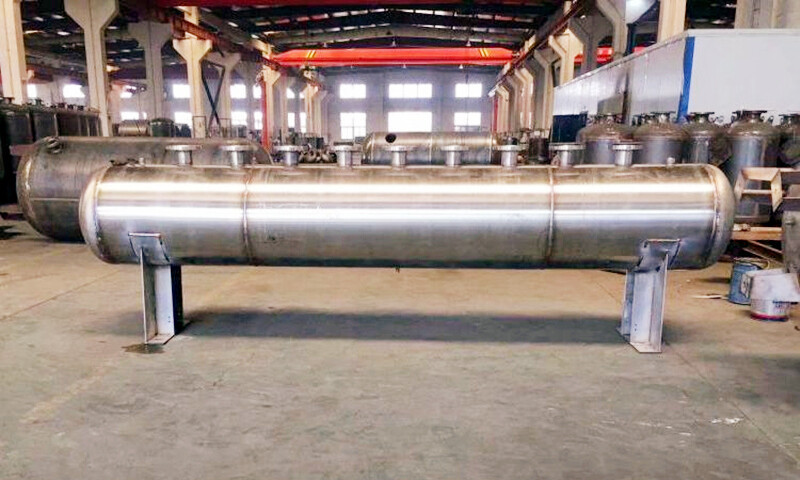
Critical Components of a Steam-Liquid Separator
To ensure continuous, efficient operation, separators include additional components beyond the core separation structure:
Inlet/Outlet Nozzles: Positioned to direct wet steam into the separator (e.g., tangential for cyclonic designs) and dry steam out. Inlets are often sized to control steam velocity (avoiding re-entrainment of settled water).
Sump (Liquid Collection Chamber): A lower reservoir where separated water accumulates. It must be sized to hold water between drainage cycles.
Drain Valve/Steam Trap: A one-way valve (e.g., float trap, thermostatic trap) attached to the sump. It automatically drains collected water without losing steam, preventing water from re-entering the steam flow.
Pressure Relief Valve (PRV): Optional but critical for safety—releases excess pressure if the separator becomes blocked, preventing rupture.
Key Performance Factors
The effectiveness of a steam-liquid separator is measured by steam dryness fraction (target: >99.5% dry steam) and pressure drop (minimal, to avoid energy loss). Performance depends on:
Steam Velocity: Too high, and water droplets may be re-entrained; too low, and separation is slow. Most designs optimize velocity to 1–3 m/s.
Separator Sizing: Must match the system’s steam flow rate (m³/h) and pressure. Undersized separators cause poor separation; oversized ones waste space and increase cost.
Maintenance: Regular cleaning of baffles, mesh, or vanes (to remove scale or debris) and inspection of drain valves (to prevent clogging) are essential.
