
- Product Knowledge
In a ship’s steam system, steam is never just “steam.” It is treated water, fuel energy, boiler chemicals, and operating cost all moving through the system together. When steam is used for heating fuel oil, cargo tanks, domestic water, or auxiliary equipment, the best practice is not to discharge it and forget it. The better solution is to recover it, condense it, and send it back to the boiler feedwater system.
This is where the atmospheric condenser becomes important.
From a heat exchanger specialist’s point of view, the atmospheric condenser is not usually the biggest heat exchanger on board. It is not as large as the main surface condenser used for a steam turbine. But in the auxiliary steam cycle, it performs a very practical job: it captures low-pressure steam and flash steam, turns them back into condensate, and helps keep the ship’s steam cycle efficient and stable.
The Position of an Atmospheric Condenser in the Ship Steam Cycle
A simplified marine steam cycle can be shown like this:
Boiler → Steam distribution line → Steam users → Atmospheric condenser → Hotwell / cascade tank / feedwater tank → Feed pump → Boiler
The boiler generates steam. The steam is distributed to different equipment on board. After the steam gives up its heat, it becomes condensate. In some parts of the system, hot condensate may also release flash steam when pressure drops.
Instead of venting this steam to atmosphere, the atmospheric condenser receives it and condenses it. The recovered condensate then flows back to the hotwell, cascade tank, deaerator, or feedwater tank.
In simple words, the atmospheric condenser helps close the loop.
What Steam Does It Usually Handle?
On many vessels, the atmospheric condenser is connected with the auxiliary steam and condensate return system. It may handle steam or flash vapor from:
- Fuel oil heaters
- Lube oil heaters
- Cargo heating systems
- Tank heating coils
- Domestic hot water heaters
- Steam-driven pumps
- Fresh water generators
- Deaerators and feedwater heaters
- Sludge oil or waste oil heating systems
- High-temperature condensate return lines
These systems often operate at lower pressure than the main steam line. When condensate returns from different users, pressure changes can create flash steam. If this vapor is not recovered, the ship loses both heat and treated water.
A well-designed atmospheric condenser helps collect this vapor and return it as useful condensate.
How the Atmospheric Condenser Works
The working principle is straightforward, but the design must be reliable.
Low-pressure steam or flash steam enters the condenser. Cooling water flows through the heat transfer tubes or channels. When the steam touches the cooled heat transfer surface, it releases latent heat and changes back into water.
The condensate then drains out and returns to the feedwater system.
Depending on the ship’s cooling system, the cooling medium may be:
- Seawater
- Fresh water
- Central cooling water
- Low-temperature freshwater cooling circuit
For marine service, the cooling water side is very important. If seawater is used, material selection must be handled carefully. CuNi, titanium, duplex stainless steel, or suitable stainless steel may be selected depending on seawater quality, chloride level, temperature, and required service life.
Why an Atmospheric Condenser Is Important on a Ship
1. It Reduces Steam Waste
If flash steam is vented directly, the energy is lost. The engine room may also become hot, humid, and uncomfortable. By condensing this steam, the atmospheric condenser recovers useful heat and keeps the system cleaner.
2. It Saves Boiler Feedwater
Boiler feedwater is not ordinary water. It has been treated to control hardness, oxygen, corrosion, and scaling. Losing condensate means the ship must add more make-up water and more chemicals. Recovering condensate reduces this cost.
3. It Improves Boiler Efficiency
Recovered condensate is already hot. When hot condensate returns to the feedwater system, the boiler needs less energy to raise it back to steam-generating temperature. This helps reduce fuel consumption and improves overall steam plant efficiency.
4. It Helps Control Flash Steam
Flash steam is common when hot condensate moves from a higher-pressure zone to a lower-pressure zone. Without a condenser, this vapor can cause noise, heat loss, visible steam discharge, and unstable condensate return. The atmospheric condenser gives this vapor a controlled place to condense.
5. It Supports Stable Operation
A stable condensate return system is important for boiler operation. If condensate return is irregular or too much steam is lost, feedwater temperature and level control can become less stable. The atmospheric condenser helps smooth this process.
Atmospheric Condenser vs. Main Surface Condenser
Many people confuse an atmospheric condenser with a main surface condenser, but their duties are different.
| Item | Atmospheric Condenser | Main Surface Condenser |
|---|---|---|
| Operating pressure | Around atmospheric pressure | Under vacuum |
| Main duty | Condense auxiliary steam and flash steam | Condense main turbine exhaust steam |
| Main purpose | Condensate recovery and heat saving | Improve turbine efficiency |
| Typical location | Auxiliary steam return system | Main turbine exhaust system |
| Heat load | Small to medium | Very large |
| Design focus | Reliability, corrosion resistance, drainage, easy cleaning | Vacuum performance, large heat transfer area, low back pressure |
The main surface condenser is part of the power cycle. The atmospheric condenser is more related to auxiliary steam management and condensate recovery.
Both are important, but they solve different problems.
Typical Construction for Marine Atmospheric Condensers
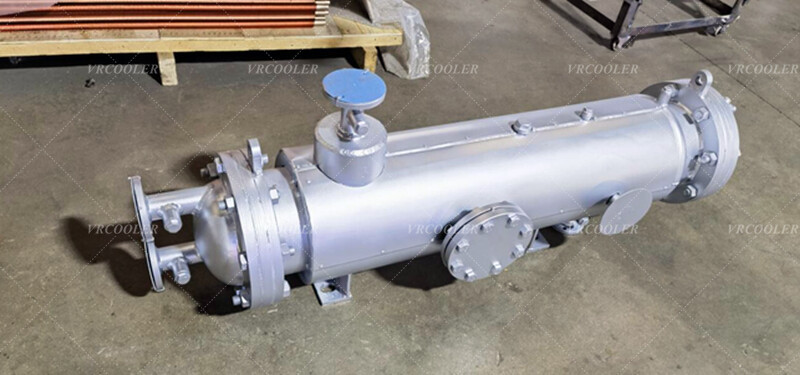
For shipboard applications, atmospheric condensers are often designed as shell and tube heat exchangers. This structure is strong, serviceable, and suitable for marine cooling water.
A typical design may include:
- Shell and tube construction
- Steam inlet connection
- Condensate outlet connection
- Cooling water inlet and outlet
- Vent connection for non-condensable gas
- Drain connection
- Removable tube bundle for cleaning
- Marine-grade materials
- Compact layout for limited engine room space
In actual projects, the nozzle direction, mounting position, cleaning space, and tube removal space are just as important as the heat transfer calculation. A condenser that looks good on paper but is difficult to inspect or clean will cause problems later.
Important Design Points from a Heat Exchanger Specialist
When we design or select an atmospheric condenser for marine service, we do not only look at heat duty. We also need to understand how the condenser will behave in real operating conditions.
Important points include:
Steam Load
The steam flow rate and flash steam quantity must be estimated correctly. If the condenser is undersized, steam may not fully condense, causing vapor discharge and unstable return.
Cooling Water Condition
Seawater temperature, fouling tendency, flow rate, and pressure drop must be confirmed. In warm seawater areas, the condenser may need more heat transfer area.
Material Selection
For seawater service, ordinary materials may fail quickly. Tube material should be selected according to corrosion risk, budget, and service life requirement.
Condensate Drainage
Condensate must drain smoothly. Poor drainage can cause water hammer, unstable operation, or reduced heat transfer surface.
Venting of Non-Condensable Gas
Air and non-condensable gas reduce heat transfer efficiency. A proper vent connection is necessary for stable condensation.
Maintenance Access
Marine equipment must be easy to maintain. Removable covers, cleanable tube sides, and enough service space should be considered during design.
Information Needed for Selection
To design a suitable atmospheric condenser, the following data is usually required:
- Steam flow rate
- Steam pressure and temperature
- Flash steam quantity, if available
- Required condensate outlet condition
- Cooling water type
- Cooling water inlet temperature
- Cooling water flow rate
- Allowable pressure drop
- Material requirement
- Installation space
- Connection direction
- Marine classification or project standard
- Fouling condition
- Cleaning method
With complete data, the condenser can be designed with proper heat transfer area, tube material, shell size, nozzle layout, and maintenance structure.
Vrcooler Marine Atmospheric Condenser Solution
Vrcooler provides customized atmospheric condensers for marine steam and condensate recovery systems. According to the vessel’s operating condition, we can design shell and tube condensers for auxiliary steam recovery, flash steam condensation, tank heating systems, and boiler feedwater return systems.
Our design can be customized for:
- Seawater or freshwater cooling
- CuNi, stainless steel, duplex stainless steel, or titanium tubes
- Carbon steel or stainless steel shell
- Removable tube bundle structure
- Compact engine room installation
- Special nozzle orientation
- Low pressure drop design
- Easy inspection and cleaning
- OEM replacement projects
For marine applications, the correct design is not only about heat transfer efficiency. It is about long-term reliability, corrosion resistance, easy maintenance, and stable operation in a demanding environment.
Conclusion
An atmospheric condenser fits into a ship’s steam cycle as a practical condensate recovery unit. It receives low-pressure steam and flash steam from auxiliary systems, condenses the vapor, and returns hot condensate back to the feedwater system.
By doing this, it helps reduce steam loss, save treated boiler water, recover heat, improve boiler efficiency, and keep the engine room safer and cleaner.
For shipowners, shipyards, and marine engineering companies, a well-designed atmospheric condenser is a small but valuable part of the complete steam system. When the material, heat transfer area, drainage, venting, and maintenance structure are correctly designed, it can provide reliable service for many years.
