- Product Knowledge
MESSAGE
How the Tube Side and Shell Side Affect the Heat Transfer Efficiency?
Time :Oct 17, 2025
How the Tube Side and Shell Side Affect the Heat Transfer Efficiency?
The heat transfer efficiency of a shell-and-tube heat exchanger depends on the combined performance of the tube side and shell side, as heat is transferred through the tube wall from one fluid to the other. The core driver of efficiency is the overall heat transfer coefficient (U), a parameter that integrates the heat transfer capabilities of both sides (along with tube wall resistance). To understand how each side impacts efficiency, we need to break down their individual contributions to heat transfer, as well as how their design and operation interact.
First: The Basics of Heat Transfer in Shell-and-Tube Exchangers
Heat transfer occurs in three sequential steps:
- Step 1: Heat transfers from the hot fluid to the inner wall of the tubes (tube-side heat transfer).
- Step 2: Heat conducts through the tube wall (fixed resistance, determined by tube material and thickness).
- Step 3: Heat transfers from the outer wall of the tubes to the cold fluid (shell-side heat transfer).
How the Tube Side Affects Heat Transfer Efficiency
The tube side’s impact on efficiency is driven by its design (tube diameter, flow passes) and operational conditions (fluid velocity, turbulence). These factors directly influence and, in turn,
1. Key Tube-Side Factors Shaping
Heat transfer in fluids relies on turbulence: turbulent flow disrupts the thin "boundary layer" of stagnant fluid at the tube wall (a major resistance to heat transfer), while laminar flow allows this layer to thicken, reducing . The tube side controls turbulence and through:
| Tube-Side Design/Operation | How It Affects & Efficiency |
|---|---|
| Fluid Velocity | - Higher velocity (e.g., from smaller tube diameters or multi-pass designs) increases turbulence, thins the boundary layer, and raises .- Example: A 2-pass tube side (fluid flows back and forth through tubes) doubles velocity compared to a 1-pass design, increasing by ~50–80% (for water).- Tradeoff: Higher velocity also increases pressure drop (energy loss), so velocity is optimized to balance efficiency and energy cost. |
| Tube Diameter | - Smaller tubes (e.g., 10–20 mm inner diameter) naturally boost velocity (for the same flow rate), enhancing turbulence and - Why: For a fixed flow rate, velocity is inversely proportional to the tube’s cross-sectional area (v∝1/A). A smaller tube forces fluid to move faster.- Limit: Tubes that are too small risk clogging (if fluid is dirty) or excessive pressure drop. |
| Flow Passes | - Multi-pass designs (e.g., 2-pass, 4-pass) use "channel heads" to redirect fluid through the tubes multiple times. This increases the fluid’s residence time (longer contact with the tube wall) and velocity—both of which improve heat transfer.- Example: A 4-pass tube side for hot oil increases htube by ~120% vs. a 1-pass design, significantly raising overall U. |
| Fouling on the Tube Side | - Fouling (mineral deposits, sludge, or scale on the inner tube wall) creates an extra thermal resistance. This reduces the effective htube (even if the fluid is turbulent) and lowers U.- Impact: For cooling water with high mineral content, fouling can reduce U by 30–50% over 6 months. - Mitigation: The tube side’s simple, linear flow path makes cleaning (brushing, chemical flushing) easy—preserving and efficiency. |
How the Shell Side Affects Heat Transfer Efficiency
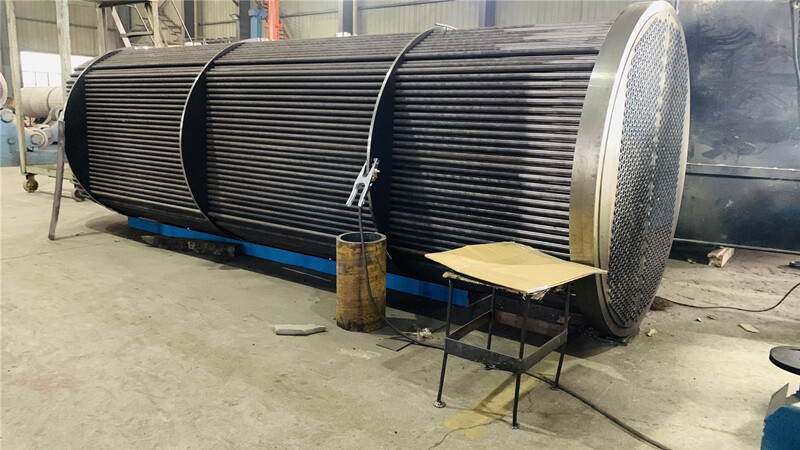
The shell side’s impact on efficiency is even more critical in many cases, as its design (baffles, flow pattern) directly controls how well the shell-side fluid interacts with the tube bundle. Unlike the tube side (which often has linear flow), the shell side uses baffles to create cross-flow (fluid moving perpendicular to the tubes)—a key driver of high hshell.
1. Key Shell-Side Factors Shaping hshell
| Shell-Side Design/Operation | How It Affects hshell & Efficiency |
|---|---|
| Baffle Design (Critical!) | - Baffles are the single most important factor for shell-side efficiency. They serve two core roles:1. Force cross-flow: Without baffles, the shell-side fluid would flow parallel to the tubes (laminar, low hshell). Baffles redirect fluid to flow perpendicular to the tubes, creating intense turbulence and thinning the boundary layer on the outer tube wall—boosting hshell by 200–400% vs. no baffles.2. Prevent bypass flow: Baffles block "short-circuiting" (fluid flowing around the tube bundle instead of through it), ensuring all shell-side fluid contacts the tubes.- Baffle Types: Segmental baffles (most common) are 25–40% cut (a portion of the baffle is removed) to balance turbulence and pressure drop. A 30% cut segmental baffle for cooling water increases hshell by ~300% vs. no baffles. |
| Shell-Side Fluid Velocity | - Higher velocity (from a smaller shell diameter or more baffles) increases turbulence and hshell. However, the shell side’s large annular space means velocity is typically lower than the tube side—making baffles essential to boost turbulence.- Example: Increasing shell-side velocity from 0.5 m/s to 1.0 m/s (via a smaller shell) raises hshell by ~80% for air. |
| Flow Pattern (Cross-Flow vs. Parallel Flow) | - Cross-flow (perpendicular to tubes) is far more efficient than parallel flow. For the same fluid and velocity, cross-flow generates 3–5x higher hshell because it disrupts the boundary layer on the tube’s outer surface more effectively.- Why: Parallel flow allows the boundary layer to grow along the tube length (thickening, increasing resistance), while cross-flow continuously "scrapes" the boundary layer, keeping it thin. |
| Fouling on the Shell Side | - Fouling on the outer tube wall (e.g., sludge from wastewater) adds thermal resistance, reducing hshell and U.- Impact: For shell-side fluids with solids (e.g., industrial wastewater), fouling can reduce U by 40–60% if not cleaned.- Challenge: The shell side is harder to clean (requires removing the tube bundle), so fouling here is a bigger threat to long-term efficiency than tube-side fouling. |