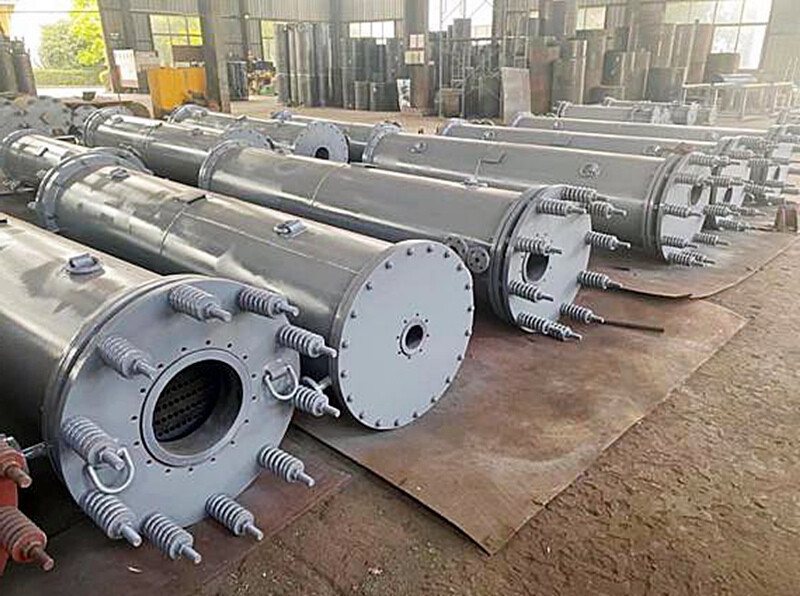
Is the Manufacturing Cost of Graphite Shell-and-Tube Heat Exchangers High?
The manufacturing cost of graphite shell-and-tube heat exchangers is relatively high, significantly exceeding that of conventional metal heat exchangers (such as carbon steel or stainless steel) but falling below that of special alloy heat exchangers (such as Hastelloy or titanium alloys). They fall within the “mid-to-high cost” category.
Core Reasons for High Cost
1. Graphite Base Material Cost: Expensive Raw Materials and Stringent Screening
The core components of graphite shell-and-tube heat exchangers (tube bundles, tube sheets, baffles) require impermeable graphite (not ordinary industrial graphite). This graphite undergoes multiple processes—“base material screening → impregnation treatment → curing and molding”—resulting in significantly higher costs than ordinary graphite:
Base Material Requirements: High-purity (fixed carbon content ≥99%) and high-density (bulk density ≥1.7g/cm³) graphite billets must be selected. Impurities (e.g., sulfur, ash content) require strict control (≤0.5%), as deviations impair corrosion resistance and thermal conductivity. Premium billet procurement costs 2-3 times that of standard graphite.
Impregnation Treatment: To address the “porous and permeable” nature of ordinary graphite, high-pressure impregnation (pressure ≥0.8MPa) with resins (e.g., phenolic resin, furan resin) or metals (e.g., antimony, lead) is required. This process fills graphite pores with the impregnating agent, forming an “impermeable structure.” This step not only increases the cost of the impregnating agent (high-quality resins cost approximately 20-40 RMB/kg) but also requires specialized high-pressure equipment and extended curing times (typically 24-72 hours), further driving up processing costs.
2. Processing Cost: High Precision Requirements and High Waste Rate
Graphite's “hard yet brittle” properties make machining significantly more challenging than metals. It requires specialized equipment and techniques, and the process is prone to cracking and chipping, resulting in low yield rates (typically only 80%-85%, compared to over 95% for metals):
Tube bundle machining: Graphite tubes must be machined into high-precision, slender tubes (e.g., Φ22/Φ32mm, 1-6m long). with smooth inner walls (roughness Ra ≤ 1.6μm to minimize fouling). This requires CNC turning or grinding using diamond tools, which wear rapidly (one diamond tool can process only 50-100 graphite tubes, costing 10-20 times more than standard metal tools).
Tube sheet to tube bundle connection: The tube sheet (graphite material) requires drilling (hole diameter tolerance ≤±0.1mm) and must be “sealed” to the graphite tubes— — Since graphite cannot be welded, specialized adhesives (high-temperature resistant, sulfuric acid corrosion resistant, unit price approx. 50-80 RMB/kg) or mechanical sealing structures are required. Assembly demands strict concentricity control to prevent leakage, significantly increasing labor and time costs.
Shell and Lining Fabrication: For “steel-lined graphite” shells (the mainstream design), graphite lining plates must be bonded to the inner wall of the steel shell. These plates require seamless splicing (gap ≤ 0.1mm) and must be pressure-cured to ensure adhesion, preventing sulfuric acid penetration and corrosion of the steel shell. The process complexity and labor costs for this step are significantly higher than for conventional steel shells.
3. Supporting Component Costs: Must Meet Corrosion Resistance Requirements
Supporting components for graphite heat exchangers—such as seals, flanges, and fasteners—must withstand the highly corrosive sulfuric acid environment. Ordinary metal parts are unsuitable, leading to higher costs:
Seals: Must employ sulfuric acid-resistant fluorocarbon rubber (e.g., FKM) or PTFE O-rings/gaskets, costing 5-8 times more than standard nitrile rubber (e.g., one Φ50mm fluorocarbon O-ring costs approx. 15-30 yuan, while nitrile rubber costs only 2-5 yuan).
Flanges and fasteners: For sulfuric acid contact, use PTFE-lined flanges or Hastelloy flanges. Fasteners must be 316L stainless steel or Hastelloy, costing 3-5 times more than standard carbon steel flanges.
Although graphite shell-and-tube heat exchangers have higher manufacturing costs, their long-term comprehensive costs (including maintenance and replacement) offer advantages:
Conventional metal heat exchangers (e.g., stainless steel) require replacement within 1-2 years in sulfuric acid environments, whereas graphite heat exchangers can operate stably for 8-12 years (with proper maintenance), resulting in a lower “average annual cost” over their lifecycle.
Compared to titanium alloy/Hastelloy heat exchangers, graphite units significantly reduce initial investment while meeting sulfuric acid corrosion requirements.
Therefore, in highly corrosive applications like sulfuric acid dilution and pickling, the higher manufacturing cost of graphite shell-and-tube heat exchangers represents a “reasonable investment for corrosion resistance and longevity,” making them a choice characterized by “high upfront cost, high reliability, and long-term economic viability.”