
Maintenance demand guiding structural choice
Fouling tendency in working conditions
In this project, the working fluid contained impurities that could lead to fouling over time. This increased the need for regular cleaning and inspection of internal components.
Requirement for frequent maintenance access
The system required periodic shutdowns for maintenance, making accessibility to the internal tube bundle an important factor in design selection.
Impact of downtime on production
Any maintenance activity directly affected production efficiency. Reducing maintenance time became a key objective for the client.
Decision based on real operating needs
The final structural choice was based on balancing maintenance convenience with system stability and cost considerations.
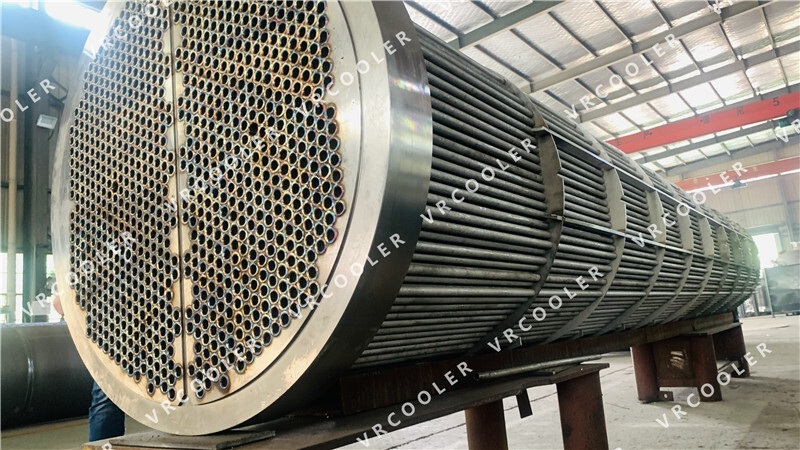
Removable tube bundle enabling easy access
Pull-out structure for internal inspection
In a removable design, the tube bundle can be extracted from the shell, allowing direct access for cleaning and inspection.
Simplified maintenance procedures
Technicians can easily clean fouling deposits and repair or replace damaged tubes without dismantling the entire exchanger.
Reduced maintenance time and effort
The ability to remove the tube bundle significantly shortens maintenance duration, minimizing system downtime.
Suitable for fouling prone systems
This design is ideal for applications where scaling, sediment, or contamination is expected.
Fixed tube bundle emphasizing structural simplicity
Integrated structure without removal feature
In a fixed design, the tube bundle is permanently installed inside the shell and cannot be removed separately.
Lower manufacturing complexity
The simpler structure reduces manufacturing difficulty and cost compared to removable designs.
Compact and space saving configuration
Without the need for extraction space, fixed units are more suitable for installations with limited available space.
Suitable for clean working media
This design works well in systems where fouling is minimal and frequent maintenance is not required.
Structural differences influencing performance
Sealing and pressure handling considerations
Fixed designs often have fewer sealing points, which can improve overall sealing reliability under pressure.
Mechanical stability under operation
The integrated structure of fixed bundles provides strong mechanical stability during operation.
Flexibility in handling maintenance needs
Removable designs offer greater flexibility in maintenance, while fixed designs prioritize simplicity and robustness.
Impact on long term operation
Choosing the right structure directly affects operational efficiency and maintenance planning over time.
Cost and lifecycle evaluation
Initial investment comparison
Fixed tube bundle exchangers generally have lower initial costs due to simpler design and fabrication.
Maintenance cost differences
Removable designs may have higher upfront costs but reduce long-term maintenance expenses.
Downtime related economic impact
Reduced downtime in removable designs can lead to significant cost savings in continuous production environments.
Lifecycle value perspective
Evaluating total lifecycle cost helps determine the most economical option for a given application.
Project outcome and practical insights
Selected design based on fouling conditions
In this case, a removable tube bundle design was chosen due to the high fouling tendency of the system.
Improved maintenance efficiency
The ability to quickly remove and clean the tube bundle significantly reduced maintenance time.
Stable operation after implementation
The exchanger maintained reliable performance with regular maintenance.
Guidance for future applications
This project demonstrates that removable designs are ideal for maintenance-intensive systems, while fixed designs suit clean and stable environments.