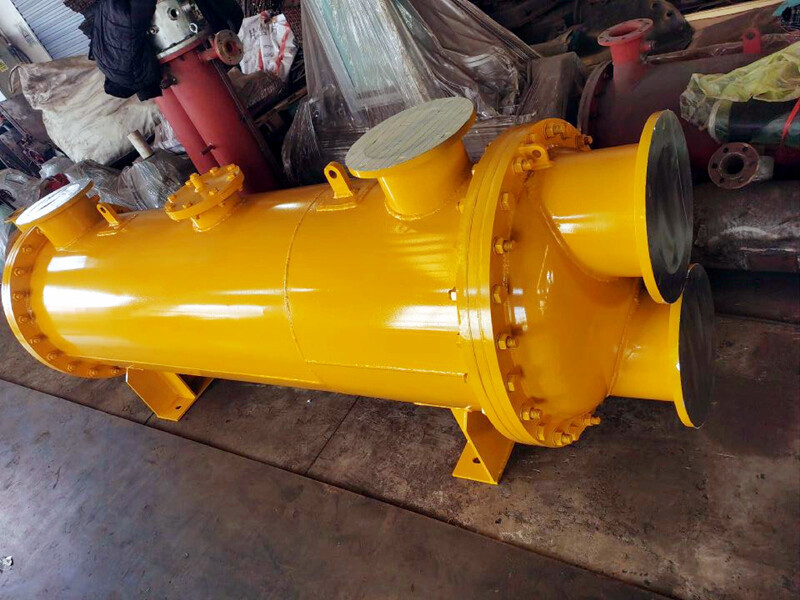
Shell Tube Heat Exchanger for Generator Cooling System
Typical application scenarios in generator cooling system
Hydro Generator Cooling System
Cooling medium:
Tube range: hot water after cooling the generator stator / rotor winding (temperature of about 50-80 ℃);
Shell range: circulating cooling water (such as river water, groundwater, temperature of about 20-35 ℃).
Characteristics: large flow rate (up to thousands of cubic meters / hour), strict requirements for the temperature difference between the heat transfer (hot water needs to be reduced to ≤ 40 ℃), the need to prevent water scaling.
Hydrogen Cooling System for Turbine Generator
Cooling medium:
Pipe course: high temperature hydrogen in the hydrogen cooler (about 60-90℃);
Shell course: cooling water (cooled down by closed circulating water system).
Characteristics: high purity of hydrogen (≥99%), heat exchanger needs to be strictly sealed to prevent hydrogen leakage causing safety hazards.
Structural composition
Shell and tube heat exchanger is mainly composed of the following parts:
Shell: to accommodate the tube bundle and provide fluid passage, the material is mostly carbon steel or stainless steel, strong pressure resistance.
Tube bundle: composed of multiple heat exchanger tubes (such as copper, stainless steel tubes), is the core component of heat exchange, the tube inside / outside the flow of cooling medium.
Tube Plate: Fixed at both ends of the tube bundle, separating the shell and tube fluids to ensure that the medium does not mix.
Folding plate/support plate: guides the direction of fluid flow in the shell stage, enhances turbulence, improves heat exchange efficiency, and supports the tube bundle to prevent vibration.
Header and receiver: the entrance and exit of the pipe process fluid, usually designed for multi-pipe (such as 2-pipe, 4-pipe) in order to regulate the flow rate.
Working Principle
In the generator cooling system, shell and tube heat exchanger usually adopts tube - shell and tube countercurrent heat transfer mode:
Hot medium (such as cooling oil or water warmed up during the generator operation) flows through the tube or shell and tube, releasing heat;
Cold medium (such as cooling water, air, or hydrogen) flows through the other side, absorbing the heat and taking it away to realize the temperature control of the generator.