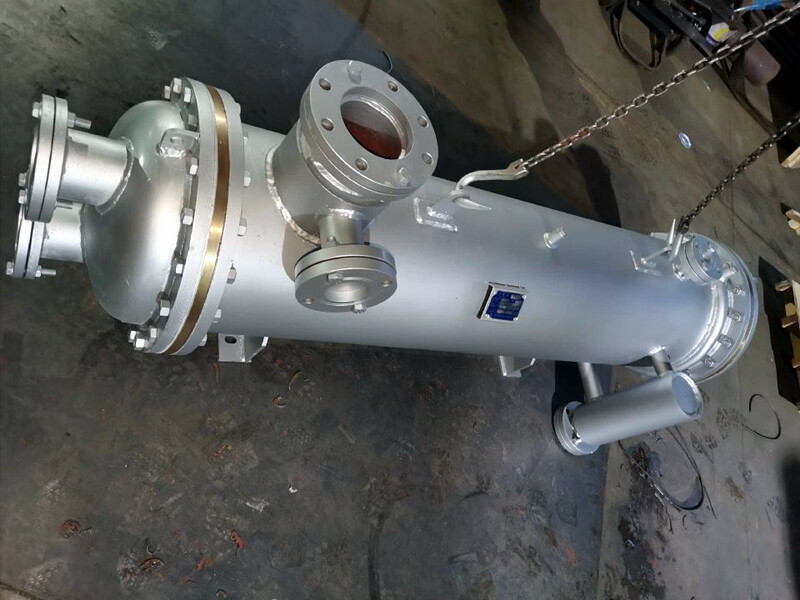
Shell Tube Heat Exchanger for Lubricating Oil Cooling System
Characteristics of lubricant medium
High viscosity: the viscosity under the operating temperature is usually 10-100 cSt (e.g., ISO VG46 lubricant viscosity is about 46 cSt at 40℃), the flow resistance is large, which is easy to lead to the decline of heat exchange efficiency;
Temperature sensitivity: the suitable working temperature is 40-60℃, over 80℃ is easy to oxidize and coking, viscosity below 30℃ increases suddenly, accurate temperature control is required;
Pollution risk: mechanical impurities, Pollution risk: mechanical impurities, metal debris or oxidation products are easy to deposit, anti-clogging design.
Advantages of shell and tube heat exchanger
High-pressure and high flow: lubricant system pressure is usually 0.3-1.0MPa, shell and tube structure can withstand more than 1.6MPa pressure, suitable for steam turbines, compressors and other high-pressure scenarios;
Anti-fouling ability: large diameter heat exchanger tubes (φ19-φ32mm) to reduce the risk of clogging, the folding plate design can enhance the fluid perturbation and inhibit the attachment of sediments;
Flexible flow design Flexible flow path design: Regulate the lubricant flow rate through multiple pipe passes (e.g. 2/4 pipe passes) to ensure turbulent flow (Reynolds number Re>2000) and improve the heat transfer coefficient.
Structural design and working principle
1. Core structure optimization
Heat exchanger tube selection:
Material: 316L stainless steel (oil oxidation corrosion resistance), copper-nickel alloy (B10, resistance to electrochemical corrosion during seawater cooling);
Surface treatment: inner surface polishing or coating (e.g., Teflon), to reduce the resistance of the adhesion of the oil film.
Folding plate design:
fan-shaped folding plate (rather than the traditional bow-shaped), reducing the dead zone volume, reducing the probability of sludge deposition;
folding plate spacing: usually 0.2-0.5 times the diameter of the shell, to avoid the flow rate is too low or too high to avoid the decline in the efficiency of heat transfer.
Shell and tube plate connection:
Welding process: automatic argon arc welding (TIG), to ensure sealing performance and prevent oil leakage (leakage rate ≤ 0.01%).
2. Heat exchanging process (take turbine lubricating oil system as an example)
Hot medium (lubricating oil, 60-80℃) → Shell process (cross-swept tube bundle)
Cold medium (cooling water, 25-35℃) → Pipe process (multi-pipe process countercurrent)
↓
Lubricating oil temperature after heat exchanging is lowered to 45-55℃, and the cooling water is warmed up to 35-45℃.
Areas of application
Turbine lubricant systems
Marine diesel engine systems
Industrial gearbox systems