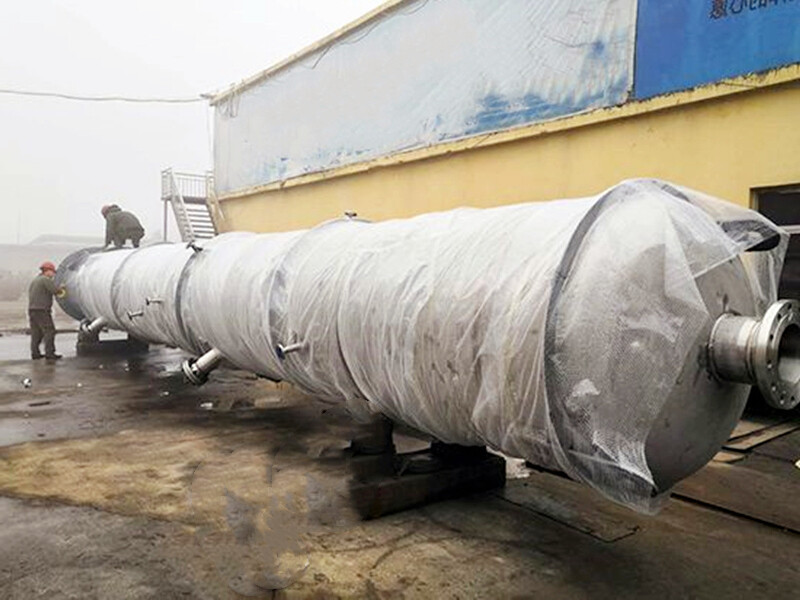
Shell Tube Oil and Gas Heat Exchanger for High Pressure and Temperature in Oil and Gas Processing Applications
A shell-and-tube heat exchanger operates on the countercurrent or crossflow heat transfer principle, where two fluid streams (the "hot fluid" and "cold fluid") exchange heat without direct contact—separated by the tube wall. For oil and gas processing:
Tube side: Typically carries the fluid with more aggressive properties (e.g., corrosive wellstream fluids, high-viscosity crude oil) or the fluid requiring precise flow control. The tubes are sealed at both ends by tube sheets, ensuring no leakage into the shell side.
Shell side: Usually handles the heat transfer medium (e.g., hot steam, heated thermal oil, or cooled water) or the fluid with lower pressure drop requirements (e.g., natural gas).
Heat transfer process: Hot fluid flows through tubes (or shell) and transfers thermal energy to the tube wall; the wall then conducts heat to the cold fluid on the opposite side. Countercurrent flow (fluids move in opposite directions) is preferred for HP/HT applications, as it maximizes the log mean temperature difference (LMTD) and heat transfer efficiency.
Common Applications in Oil & Gas Processing
Shell-and-tube exchangers are tailored to specific HP/HT tasks in the oil and gas value chain:
Upstream (Wellhead & Production):
Wellstream cooling: Cools high-temperature (300–500°C) well fluids (crude oil + natural gas + water) from the wellhead to a manageable temperature (<150°C) for separation (oil-gas-water separation).
Hydrate prevention: Heats natural gas streams (at 10–20 MPa) to prevent hydrate formation (ice-like crystals that block pipelines) using hot glycol or steam as the heat source.
Midstream (Pipeline & Transportation):
Pipeline heating: Maintains crude oil temperature (e.g., 50–80°C) in high-pressure pipelines (up to 15 MPa) to reduce viscosity and ensure smooth flow (especially for heavy crude).
Compressor aftercooling: Cools high-pressure (15–30 MPa) compressed natural gas (CNG) from compressors (which heat up during compression) to avoid equipment overheating.
Downstream (Refining & Petrochemicals):
Hydrocracking/hydrotreating units: Heats feedstock (crude oil fractions) to 350–450°C and 10–20 MPa using hot reactor effluent (recovering waste heat to reduce fuel consumption).
Steam generation: Transfers heat from flue gas (HT) or hot process streams (HP) to water to produce high-pressure steam (used for turbine power or process heating).