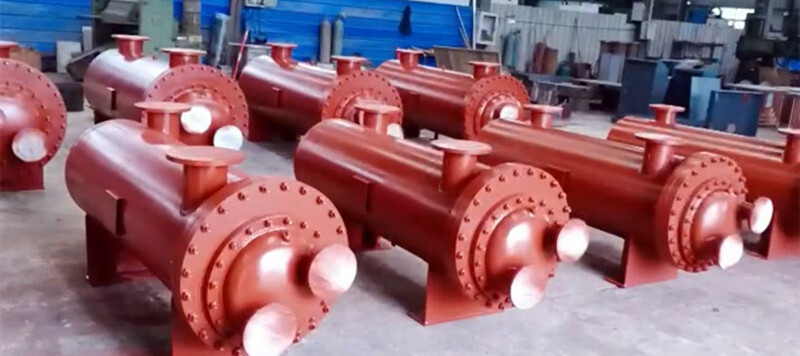
Shell Tube Type Dry Expansion Evaporator for Process Cooling
A shell tube type dry expansion evaporator for process cooling is a kind of heat exchange equipment widely used in industrial refrigeration systems. It realizes the cooling of the secondary fluid by using the evaporation of the refrigerant.
Structure and Working Principle
Structure: It is composed of a shell, tubes, tube plates, baffles, and end covers. The tubes are installed in the shell through the tube plates, and the end covers are located at both ends of the shell. The baffles are arranged across the tube bundle in the shell to increase the flow velocity of the secondary fluid outside the tubes.
Working Principle: The liquid refrigerant enters the tube side from the end cover at one end of the evaporator after throttling. The end cover is cast with a partition plate, and the refrigerant evaporates after two or more processes, absorbing the heat of the secondary fluid (usually water or brine) outside the tubes. The evaporated refrigerant gas enters the compressor from the same end cover to complete the refrigeration cycle.
Characteristics
Less Refrigerant Charge: The refrigerant charge is only about 35% - 40% of the internal volume of the tube group, which is about one - third of that of the flooded evaporator of the same cooling capacity, reducing the operating cost.
Convenient Oil Return: Since the refrigerant evaporates in the tube, as long as the flow velocity in the tube exceeds 4m/s, the lubricating oil in the tube can be returned to the compressor, and the oil return is convenient.
Good Adaptability: It can be used in systems with various working temperatures and pressure ranges, and the pressure drop is small. It is easy to carry out pressure tests and locate pipeline leaks.
Higher Heat Transfer Efficiency: The heat exchange tubes usually use internally threaded high - efficiency tubes, which increase the heat exchange area by 20% - 50% compared with smooth tubes, effectively improving the heat transfer efficiency.
Applications
Industrial Refrigeration: In industries such as food processing and chemicals, it is used to cool the secondary fluid (such as ethylene glycol solution), and then the secondary fluid provides the required low - temperature environment for the production process. For example, in food freezing workshops, it can quickly freeze and refrigerate food.
Central Air - Conditioning Systems: It is an important component of air - conditioning units in large - scale office buildings. It exchanges heat with chilled water to cool the chilled water, and then the low - temperature chilled water is transported to the fan coils in each room to achieve indoor air cooling and regulation.
Laboratory Equipment: In scientific research laboratories, it can be used to construct low - temperature environment simulation systems, such as providing a stable low - temperature environment for material science research and biological sample storage.