
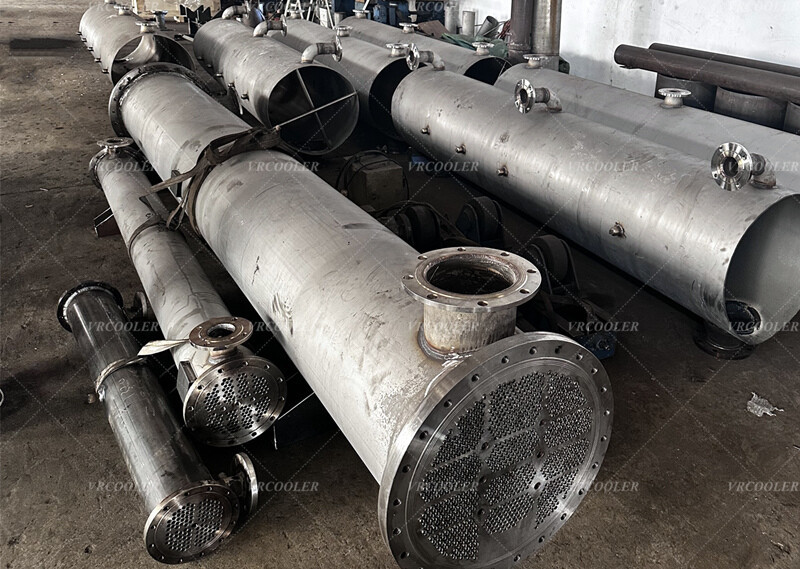
The shell and tube configuration is especially suited for gas heating applications due to its mechanical strength, stable thermal performance, and ability to operate under continuous-duty conditions.
Working Principle
In this application:
Carbon dioxide (CO₂) flows through the tube side of the heat exchanger
Hot water vapor circulates through the shell side
Heat is transferred through the tube walls by conduction and convection
CO₂ temperature increases to the required outlet condition
Hot water vapor cools and exits the shell side
The indirect heat exchange ensures safe operation, prevents contamination, and allows precise temperature control.
Process Conditions
Tube Side (Cold CO₂):
Carbon dioxide flows through the tubes at a mass flow rate of 0.198 kg/s (1185.502 kg per run) and a volumetric flow rate of 0.8048 m³/h. The inlet temperature is 288.15 K, and the outlet temperature is 338.2 K, with an average operating temperature of 313.15 K.Shell Side (Hot Water Vapor):
Water vapor circulates through the shell with a mass flow rate of 0.318 kg/s, entering at 348.15 K and exiting at 333.15 K, with an average temperature of 340.65 K.
Application Areas
Shell and tube heat exchangers for CO₂ heating are widely applied in:
Industrial gas processing systems
CO₂ compression and conditioning units
Energy recovery and heat integration systems
Chemical and petrochemical plants
Power and utility facilities
Thermal Performance
The heat exchanger is designed to deliver the required heating duty through an optimized balance of heat transfer area, overall heat transfer coefficient, and temperature driving force. The shell-side hot water vapor provides a stable heat source, while the tube-side CO₂ absorbs thermal energy efficiently as it flows through the exchanger.
The shell and tube design allows consistent performance even with variations in flow rate or inlet temperature.
Custom Engineering and Manufacturing
Each shell and tube heat exchanger for CO₂ heating is custom-engineered based on:
CO₂ flow rate and temperature requirements
Hot water vapor temperature and mass flow
Allowable pressure drops
Installation space and operating conditions
Advanced thermal design and proven fabrication standards ensure predictable performance and long-term reliability.
Conclusion
A Shell and Tube Heat Exchanger for CO₂ Heating Using Hot Water Vapor provides a dependable and efficient solution for controlled gas heating in industrial applications. With its robust design, high thermal efficiency, and operational flexibility, it is an ideal choice for systems requiring precise CO₂ temperature control using a vapor-based heat source.
