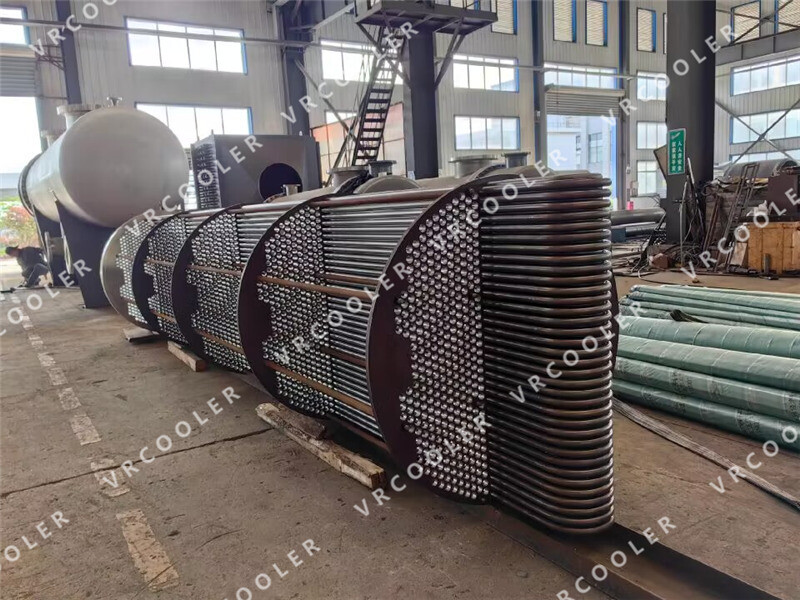
Shell and Tube Heat Exchanger for Large-scale Industrial Production
Design Features
Structure:
Shell: A cylindrical outer container that holds one of the fluids.
Tubes: A series of tubes run through the shell, allowing the second fluid to flow inside them.
Configuration:
Single Pass: Fluids flow through the shell and tubes in one pass.
Multi-Pass: Fluids can be routed through multiple passes to enhance heat transfer efficiency.
Materials:
Typically made from metals like stainless steel, carbon steel, or titanium, depending on the fluids and operating conditions.
Operation
Heat Transfer Process:
One fluid (hot) flows through the shell, while the other fluid (cold) circulates through the tubes.
Heat is transferred from the hot fluid to the cold fluid through the tube walls.
Flow Arrangement:
Counterflow: Fluids flow in opposite directions, maximizing temperature difference and heat transfer.
Parallel Flow: Fluids flow in the same direction, less efficient than counterflow.
Applications
Chemical Processing: Used to control temperatures in reactors and separation processes.
Oil and Gas: Employed for heating and cooling crude oil, natural gas, and refined products.
Power Generation: Used in condensers and cooling systems in power plants.
HVAC Systems: Utilized in chillers and heat recovery systems.
Advantages
High Efficiency: Effective heat transfer due to large surface area.
Versatility: Suitable for a wide range of temperatures and pressures.
Scalability: Can be designed for various sizes to meet industrial needs.