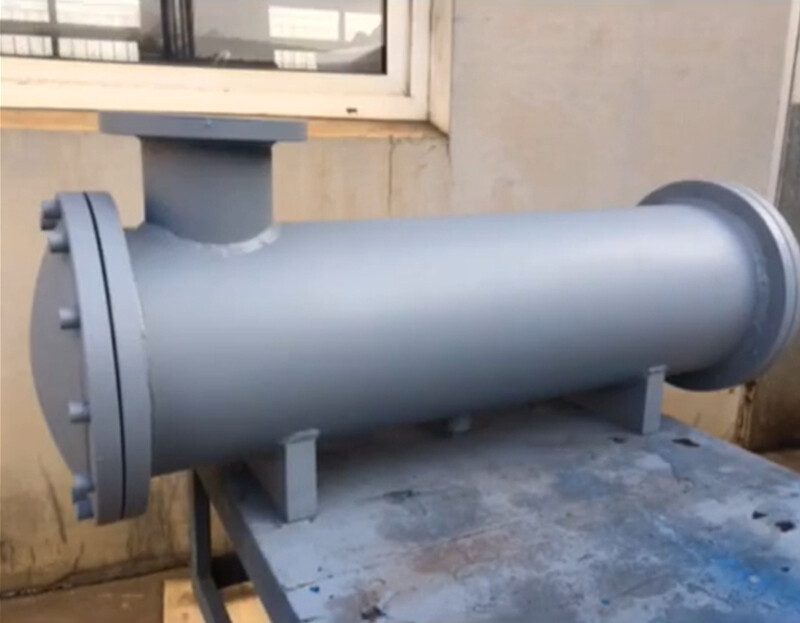
Shell and Tube Heat Exchangers for Hydroelectric Power Plants
The core application of shell and tube heat exchanger in hydropower plant
Generator Cooling System
Function: The stator, rotor windings and iron core generate a lot of heat during the operation of hydro generator, which needs to be transferred to the cooling water (fresh water or seawater) through shell and tube heat exchanger.
Working condition parameters:
Cooling medium: fresh water (closed loop) or river water / seawater (open loop);
Design temperature difference: tube side (generator cooling water) inlet about 40 ℃, outlet ≤ 50 ℃; shell and tube side (cooling water) temperature rise of about 5-10 ℃;
Material selection: seawater cooling with titanium alloy or copper-nickel alloy (B30) tube bundle, to prevent corrosion of chlorine ions.
Lubricating Oil Cooling System
Application Scenario: The lubricating oil of hydraulic turbine bearings and gearboxes needs to maintain the appropriate temperature (40-50℃), and exchanges heat with cooling water through shell and tube heat exchanger.
Technical points:
Oil-side flow rate is controlled at 0.5-1m/s, and water-side flow rate is ≥1.5m/s, so as to improve the heat transfer coefficient;
adopts spiral folding plate to optimize the flow field on the shell side, so as to reduce the resistance loss.
Transformer cooling system
Function: the oil temperature rises when the oil-immersed transformer is running, and it exchanges heat with cooling water through shell and tube heat exchanger (or casing heat exchanger) to maintain the oil temperature ≤85℃.
Special design: high temperature resistant sealing materials (such as fluorine rubber) are used to prevent hot oil leakage; pressure protection device is set to avoid overpressure.
Structural features: It consists of shell, tube bundle, tube plate, header and folding plate, etc. The hot fluid and cold fluid flow in the shell side (inside the shell) and tube side (inside the tube bundle) respectively, and heat exchange is realized through the tube wall.
Typical types:
Fixed tube plate type: simple structure, suitable for small temperature difference, clean water conditions;
Floating head type: one end of the tube plate can be free to expand and contract, to compensate for thermal expansion, to facilitate the cleaning of the tube bundle;
U-shaped tube type: the tube bundle is U-shaped, can be free to expand, easy to clean the inside of the tube, suitable for high temperature, high pressure scenarios.