
Shell-and-Tube Heat Exchangers for Industrial Air Compressors Exhaust Gas Recovery
Shell-and-tube heat exchangers are a widely used design for exhaust gas heat recovery in industrial air compressors, valued for their robustness, efficiency, and ability to handle the high temperatures, pressures, and contaminant-laden exhaust streams typical of large engine-driven compressors.
A shell-and-tube heat exchanger is a type of heat transfer device consisting of a cylindrical “shell” enclosing a bundle of tubes. In the context of industrial air compressors, it is specifically engineered to recover waste heat from the high-temperature exhaust gases of the compressor’s engine (e.g., diesel, natural gas, or propane-fueled engines) and transfer it to a usable medium (e.g., water, thermal oil, or glycol).
This design is favored for large-scale industrial compressors (often 100 kW or higher) due to its ability to handle the demanding conditions of compressor exhaust: high flow rates, elevated temperatures (300–600°C), and contaminants like soot, moisture, or corrosive byproducts.
The structure of a shell-and-tube heat exchanger for exhaust recovery is tailored to maximize heat transfer while withstanding harsh exhaust conditions. Its core components include:
Shell: A rigid cylindrical vessel (typically carbon steel or stainless steel) that houses the tube bundle and directs the flow of one fluid (either exhaust gas or coolant).
Tube Bundle: A set of parallel tubes (usually stainless steel, Inconel, or nickel alloys) through which the second fluid flows. Tubes may be smooth or finned (internally or externally) to enhance heat transfer surface area.
Tube Sheets: Thick metal plates at either end of the shell that secure the tube bundle, separating the shell-side and tube-side fluids to prevent mixing.
Headers (Channel Covers): Enclosures attached to the tube sheets that distribute and collect the tube-side fluid (e.g., coolant).
Baffles: Plates inside the shell that direct the flow of the shell-side fluid (e.g., exhaust gas) across the tube bundle, promoting turbulence and improving heat transfer efficiency. Baffles also support the tubes to prevent vibration.
Nozzles: Inlet/outlet ports for exhaust gas, coolant, and (in some cases) vents or drains to manage condensation.
In compressor exhaust applications, shell-and-tube heat exchangers operate on a counterflow principle (the most efficient configuration) to recover heat:
Exhaust Gas Inlet: High-temperature exhaust from the compressor’s engine enters the shell (or, less commonly, the tubes) at 300–600°C.
Shell-Side Flow: Exhaust gas flows through the shell, guided by baffles, which force it to pass over the external surface of the tube bundle. Turbulence from baffles ensures maximum contact with the tubes, enhancing heat transfer.
Tube-Side Flow: A cooler medium (e.g., water, glycol, or thermal oil) is pumped through the tubes. As exhaust gas passes over the tubes, heat transfers through the tube walls to the cooler medium.
Heat Transfer: The exhaust gas cools as it releases heat, while the tube-side medium warms (often to 80–150°C, depending on the application).
Outlets:
Cooled exhaust gas exits the shell at 150–300°C (reducing thermal pollution) and is vented.
The heated medium exits the tube headers and is directed to its end use (e.g., a hot water storage tank, space heating loop, or industrial process).
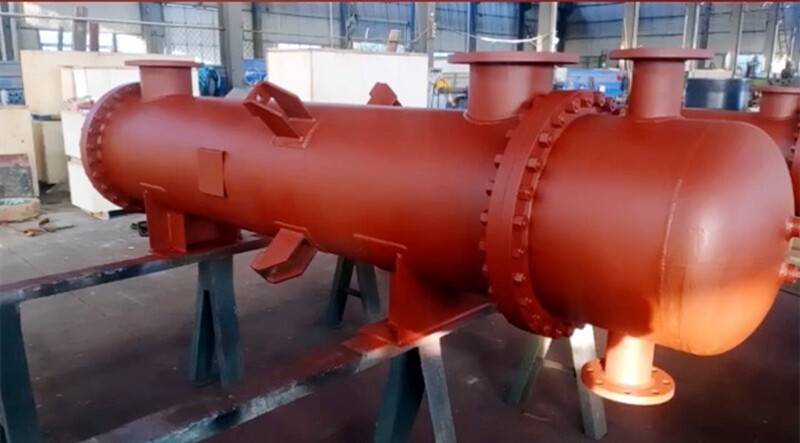
Compared to other heat exchanger types (e.g., plate, finned-tube), shell-and-tube designs offer unique benefits for compressor exhaust recovery:
High Temperature/Pressure Tolerance: Handles exhaust temperatures up to 600°C and system pressures up to 100 bar, suitable for large industrial compressors.
Robustness with Contaminated Exhaust: Soot, oil mist, and particulates (common in compressor exhaust) are less likely to damage or clog shell-and-tube designs compared to plate heat exchangers (which have tight gaps).
Ease of Maintenance: Removable tube bundles and access to the shell allow for mechanical cleaning (brushing, pigging) or chemical descaling, critical for maintaining efficiency in dirty environments.
Scalability: Can be sized for small (50 kW) to very large (10+ MW) compressors by adjusting the number of tubes, shell diameter, or adding multiple passes.
The thermal energy recovered via shell-and-tube heat exchangers from compressor exhaust is reused in industrial settings for:
Preheating boiler feedwater (reducing boiler fuel use).
Heating process water (e.g., for cleaning, dyeing, or food processing).
Space heating for workshops, warehouses, or production facilities.
Generating low-pressure steam (via a secondary heat exchanger).
