
Engineered Geometry Creating Maximum Heat Transfer Density
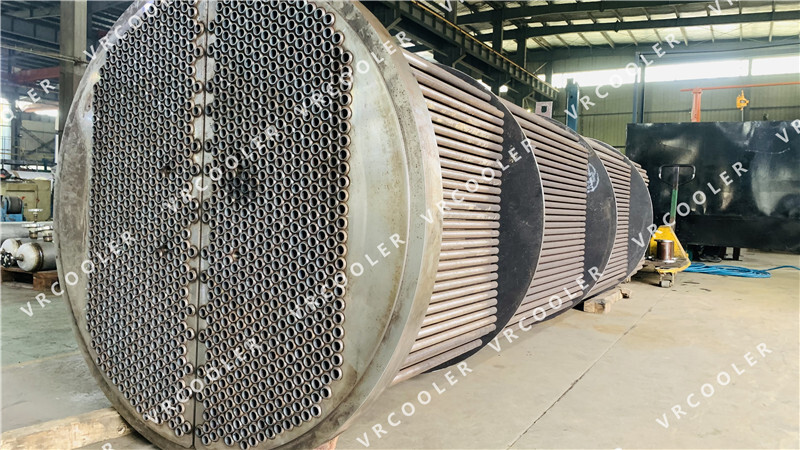
The tube bundle is composed of numerous parallel tubes fixed into one or two tube sheets, forming the central heat transfer core. Its structural precision directly influences exchanger efficiency and mechanical stability.
Tubes are arranged in triangular or square pitch layouts depending on performance requirements.
Tube sheets provide rigid anchoring and ensure sealing between fluids.
Support plates or baffles prevent tube vibration caused by fluid flow.
Expansion gaps are designed to accommodate thermal movement.
This engineered geometry maximizes heat transfer surface area while maintaining structural integrity under operating pressure and temperature variations.
Indirect Thermal Exchange Safeguarding Fluid Separation
At the heart of the tube bundle’s function lies its indirect heat transfer mechanism. Two different media exchange energy without direct contact, ensuring safe and controlled operation.
Cooling water, seawater, or process fluid flows inside the tubes.
Oil, gas, or another medium circulates around the tubes.
Heat energy passes through the metallic tube walls due to temperature difference.
Complete physical separation eliminates contamination risk.
This separation principle is critical in marine systems, where seawater must never mix with lubricating oil or freshwater circuits.
Marine Cooling Roles Supporting Vessel Operations
Onboard ships, tube bundles serve as the functional core of multiple cooling devices essential for engine performance and onboard systems.
Main engine lube oil coolers maintain optimal lubrication temperature.
Jacket water coolers regulate engine thermal balance.
Central seawater coolers support auxiliary systems.
Refrigeration condensers assist in onboard climate control and storage.
Because vessels operate continuously under dynamic conditions, the tube bundle must handle vibration, fluctuating loads, and constant exposure to salt-laden air.
Material Selection Adapting to Harsh Ocean Environments
Marine service requires enhanced corrosion resistance and mechanical durability. Tube bundles are designed with careful material consideration.
Copper-nickel alloys provide excellent seawater corrosion resistance.
Stainless steel options enhance strength for high-pressure systems.
Protective coatings reduce scaling and biofouling.
Reinforced tube sheet thickness ensures long-term sealing reliability.
Such material engineering enables reliable performance even under aggressive saline conditions and temperature cycles.
Broad Industrial Applications Beyond Shipboard Systems
While widely used in marine cooling, tube bundles also play critical roles in land-based industrial facilities.
Oil and gas compression stations use them as aftercoolers.
Power plants rely on them for turbine oil cooling.
Chemical plants apply them in condensers and reboilers.
Manufacturing processes utilize them for thermal control of equipment.
Their adaptable configuration allows customization in tube diameter, length, wall thickness, and alloy selection to match specific process demands.
Replaceable Core Concept Enhancing Lifecycle Value
One of the most practical advantages of tube bundle assemblies is their modular replacement capability. Instead of replacing the entire exchanger shell, operators can renew only the tube bundle when performance declines.
Reduces capital expenditure compared to full equipment replacement.
Minimizes downtime during maintenance periods.
Allows performance upgrades through redesigned tube layouts.
Simplifies cleaning and inspection procedures.
This replaceable-core philosophy significantly extends system lifespan and supports cost-effective long-term operation.