
A tubular oil-water heat exchanger is a reliable cooling solution used to remove heat from lubricating oil, hydraulic oil, gearbox oil, turbine oil, coupling oil and other industrial oil circuits. In heavy-duty machinery, oil is not only used for lubrication. It also carries heat away from bearings, gears, shafts, seals, couplings and rotating components. If the oil temperature becomes too high, the oil viscosity drops, lubrication performance becomes unstable, and the equipment may face accelerated wear or unexpected shutdown.
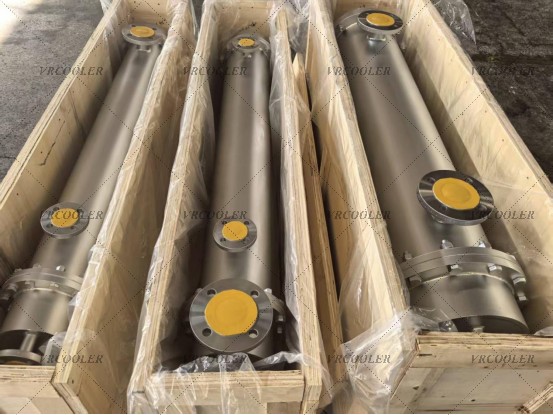
The tubular oil-water heat exchanger uses cooling water to absorb heat from hot oil. Oil and water flow through separate channels, and heat is transferred through the tube wall. This design keeps both fluids separated while providing efficient heat exchange. Because of its strong structure, pressure resistance and easy maintenance, the tubular design is widely used in power plants, steel plants, marine systems, hydraulic stations, turbines, compressors, gearboxes and industrial production lines.
Compared with air-cooled oil coolers, a water-cooled tubular oil cooler can provide more stable cooling performance in a compact size. Cooling water has a much higher heat capacity than air, so the heat exchanger can remove large amounts of heat with a smaller footprint. This is especially useful for equipment rooms, enclosed machinery, high-temperature workshops and applications where stable oil temperature is critical.
A typical tubular oil-water heat exchanger includes a shell, tube bundle, tube sheets, baffles, end covers, oil connections, water connections, sealing parts and mounting supports. Depending on the design, oil may flow through the shell side while cooling water flows through the tubes, or the arrangement may be reversed according to cleaning requirements, pressure drop limits and operating conditions. For cooling water with scaling or fouling risk, placing water inside the tubes is often preferred because tube-side cleaning is easier.
Material selection is one of the most important factors in oil-water heat exchanger design. For general industrial cooling water, copper tubes, brass tubes, stainless steel tubes or carbon steel shells may be suitable. For seawater, river water or aggressive cooling water, copper-nickel, stainless steel, duplex stainless steel or titanium tubes can be selected to improve corrosion resistance. The final material should be chosen according to water quality, oil type, working temperature, pressure rating and service life requirement.
The heat exchanger must also be designed with proper flow velocity. If cooling water velocity is too low, heat transfer performance drops and the risk of fouling or corrosion increases. If velocity is too high, erosion may occur, especially with poor water quality. On the oil side, the design should avoid dead zones and excessive pressure drop, because stable oil circulation is essential for protecting the main equipment.
For replacement projects, dimensional matching is just as important as thermal performance. The new tubular oil-water heat exchanger should match the original installation space, nozzle direction, flange size, mounting base, drainage point, vent position and maintenance clearance. A correct replacement design can reduce site modification, shorten shutdown time and allow the existing oil and water piping system to remain in use.
Vrcoolertech can customize tubular oil-water heat exchangers according to project technical data, original drawings, site measurements or old cooler samples. The design can be adjusted for oil flow rate, cooling water flow rate, inlet and outlet temperatures, allowable pressure drop, working pressure, test pressure, oil capacity, tube material, shell material and connection standard.
A well-designed tubular oil-water heat exchanger helps maintain stable oil viscosity, reduce equipment temperature, protect mechanical parts and improve operating reliability. For continuous industrial systems, it is not only a cooling component but also an important protection device for the whole machine.
Case Study: Replacement Tubular Oil-Water Heat Exchanger for Industrial Oil Cooling
A customer required a replacement tubular oil-water heat exchanger for an existing industrial oil cooling system. The original unit was used for oil temperature control in heavy-duty rotating equipment. Since the existing cooler had been operating for many years, the customer needed a new replacement unit that could match the original pressure rating, cooling water conditions and installation requirements.
The reference oil-water heat exchanger had an oil capacity of 88 liters. Cooling water flow was specified at 45 m³/h rated flow, with a minimum flow requirement of 30 m³/h. The cooling water entered the heat exchanger at 35°C and left at approximately 48°C, meaning the water side had to remove a large amount of heat from the oil circuit during continuous operation.
Both oil side and water side were designed for 10 bar admissible operating overpressure, with 15 bar test pressure on each side. These pressure requirements showed that the replacement heat exchanger needed a strong tubular construction, reliable sealing and strict pressure testing before delivery.
For this case, Vrcoolertech designed a custom tubular oil-water heat exchanger according to the original operating conditions and dimensional requirements. The key design focus was to keep stable oil cooling performance, maintain sufficient cooling water velocity, control pressure drop and ensure compatibility with the existing piping system.
The replacement heat exchanger was designed with a robust shell and tube structure. Tube material selection could be adjusted according to the customer’s cooling water quality, with available options such as copper alloy, stainless steel, copper-nickel or titanium. The tube bundle arrangement was optimized to provide enough heat transfer area while keeping the unit easy to inspect and maintain.
After replacement, the new oil-water heat exchanger helped restore stable oil temperature control and improved the reliability of the equipment. By replacing only the heat exchanger instead of modifying the whole oil cooling system, the customer reduced downtime and avoided unnecessary changes to the existing installation.
