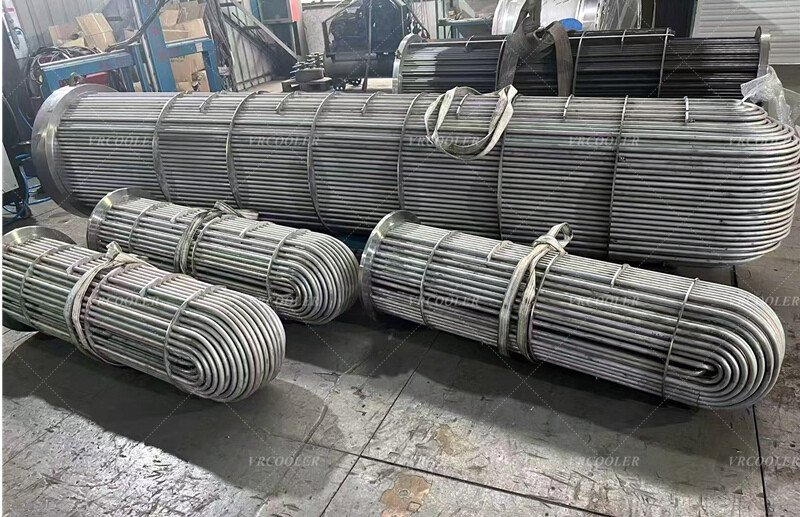
What Is A U-tube Bundle in A Heat Exchanger?
A U-tube bundle is a key component in shell-and-tube heat exchangers, one of the most common types of heat exchangers used in industrial processes (e.g., chemical processing, power generation, HVAC, and refrigeration). Its design and function are critical to efficient heat transfer between two fluids.
Basic Structure of a U-Tube Bundle
A U-tube bundle consists of multiple U-shaped tubes (bent into a "U" shape) that are mounted inside the shell of the heat exchanger. The tubes are typically made of metals like carbon steel, stainless steel, copper, or titanium (depending on fluid compatibility and temperature/pressure requirements).
U-bend design: Each tube is bent at one end to form a hairpin (U) shape, allowing the tube to have two open ends on the same side of the exchanger (unlike straight tubes, which have ends on opposite sides).
Tube sheets: The open ends of the U-tubes are secured (via rolling, welding, or brazing) to a single tube sheet (a thick metal plate) at the "straight" end of the bundle. The U-bend end is unsupported or held in place by tube supports (e.g., baffles) to prevent vibration.
Role in Heat Exchanger Operation
In a shell-and-tube heat exchanger, two fluids (a "tube side" fluid and a "shell side" fluid) exchange heat without mixing. The U-tube bundle facilitates this process as follows:
Tube side fluid: Flows into the straight ends of the U-tubes, travels through one leg of the U, turns at the bend, and flows back through the other leg before exiting—all within the same tube sheet.
Shell side fluid: Flows around the exterior of the U-tubes within the shell, transferring heat through the tube walls to (or from) the tube side fluid.
Heat transfer: The U-shape maximizes the length of contact between the two fluids, ensuring efficient thermal exchange. Baffles inside the shell direct the shell-side fluid across the tubes, increasing turbulence and enhancing heat transfer.
Key Advantages of U-Tube Bundles
The U-tube design offers unique benefits compared to other tube bundle types (e.g., straight tubes, floating head bundles):
Thermal expansion flexibility: U-tubes can expand or contract freely with temperature changes. Since only one tube sheet is fixed, the U-bend acts as a "flexible joint," accommodating thermal stress without damaging the tubes or tube sheet. This makes them ideal for high-temperature/pressure applications (e.g., steam systems, chemical reactors).
Lower maintenance complexity: With only one tube sheet, there are fewer gaskets and joints to seal, reducing the risk of leaks. This simplifies assembly and disassembly for cleaning or inspection.
Cost-effectiveness: Compared to floating head designs (which require additional components to handle expansion), U-tube bundles are often cheaper to manufacture while maintaining durability in harsh conditions.
Limitations to Consider
Despite their advantages, U-tube bundles have some drawbacks:
Cleaning challenges: The U-bend creates a narrow, curved space that is difficult to clean internally (e.g., with brushes or high-pressure water). This makes them less suitable for tube-side fluids that contain particulates, sludge, or scaling agents (which can block the tubes over time).
Flow restriction: The U-bend increases fluid pressure drop on the tube side, which may require higher pumping power to maintain desired flow rates.
Limited tube count: The U-bend design requires more space between tubes, reducing the total number of tubes that can fit in a given shell diameter compared to straight-tube bundles. This may limit heat transfer capacity in some applications.
Common Applications
U-tube bundles are widely used in scenarios where thermal expansion is a concern and tube-side fluids are relatively clean:
Power plants: For cooling turbine lubricating oil or condensing steam.
Chemical processing: For heat transfer in corrosive environments (using alloy tubes).
Refineries: In processes like crude oil heating or coolant systems.
HVAC: In large chillers or industrial cooling towers.