
What Is a Shell and Tube Water Cooled Condenser?
it's a heat exchanger that uses water to condense a refrigerant vapor (like Freon) back into a liquid. It is a critical component in water-cooled chiller systems and large refrigeration cycles.
The primary function is the opposite of an evaporator. It rejects heat from the refrigerant system to the water.
Input: Hot, high-pressure refrigerant vapor from the compressor; cool water from a cooling tower.
Output: Warm water leaving to reject its heat elsewhere; condensed, high-pressure liquid refrigerant.
Design and Configuration
The most common configuration for a refrigerant condenser is the Refrigerant in the Shell, Water in the Tubes.
In this design:
Refrigerant (Freon) is in the Shell.
Water is in the Tubes.
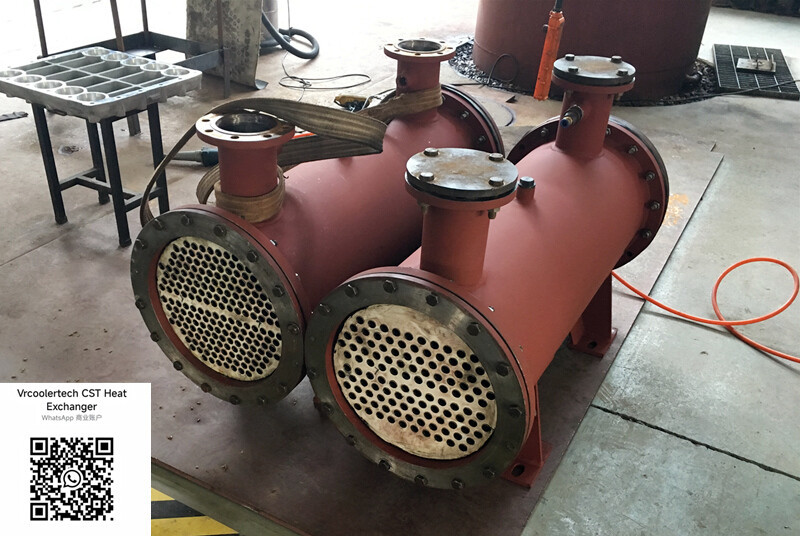
Here’s a step-by-step breakdown of how it works:
1. Refrigerant Side (Inside the Shell)
Entry: Superheated, high-pressure refrigerant vapor from the compressor enters the top of the shell.
Heat Rejection & Condensation: As the hot vapor comes into contact with the cooler tube surfaces, it does two things:
Desuperheats: It first gives up sensible heat, cooling down to its saturation temperature (condensing point).
Condenses: It then releases its latent heat of condensation, changing phase from a vapor to a liquid. This is the main function of the condenser.
Liquid Collection & Subcooling: The condensed liquid refrigerant falls to the bottom of the shell (which acts as a receiver). As it sits there, it may give up a little more heat to the incoming cool water, becoming subcooled liquid (liquid cooled below its condensation temperature). This improves system efficiency.
Exit: The high-pressure subcooled liquid refrigerant exits the bottom of the shell and flows to the expansion valve.
2. Water Side (Inside the Tubes)
Entry: Cool water from a cooling tower (typically around 29°C) enters the condenser through a header and is distributed through the tubes.
Flow: The water flows through the tubes in one or more passes (a "two-pass" design is common, where the water travels the length of the shell twice).
Heat Absorption: The water absorbs sensible and latent heat from the hot refrigerant on the shell side.
Exit: The now warm water (typically leaving around 35°C) exits the tubes, returns to the cooling tower, where it is cooled by evaporation before being pumped back to the condenser.
