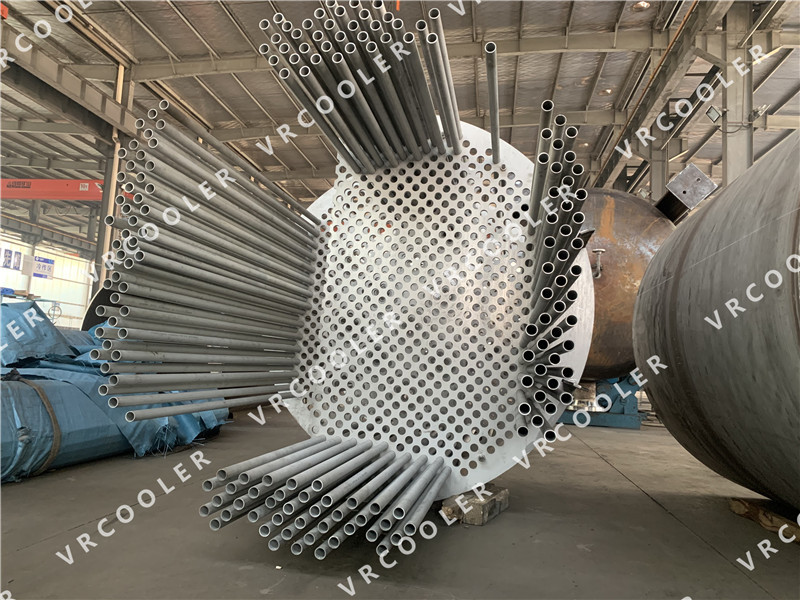
S31803, S32205, S32750 and 254 SMO are high-alloy stainless steels used in shell-and-tube heat exchangers where 304 or 316L cannot provide sufficient corrosion resistance.
S31803 and S32205 are commonly used for cooling water, brackish water, chemical processing and moderately aggressive chloride service. S32205 is now more frequently specified because its chemistry provides more reliable corrosion performance.
S32750 is selected for more severe environments, including seawater, offshore platforms, desalination plants and high-chloride process streams. Its pitting-resistance equivalent number, or PREN, is generally above 40.
254 SMO is also suitable for severe chloride environments. Because it is fully austenitic, it can be preferred when fabrication requirements, low-temperature toughness or process conditions make duplex materials less suitable.
These alloys may be used for heat-exchanger tubes, tube sheets, shells, channel covers or wetted internal components. Final selection should consider chloride concentration, temperature, pH, pressure, flow velocity and the possibility of crevice or galvanic corrosion.