
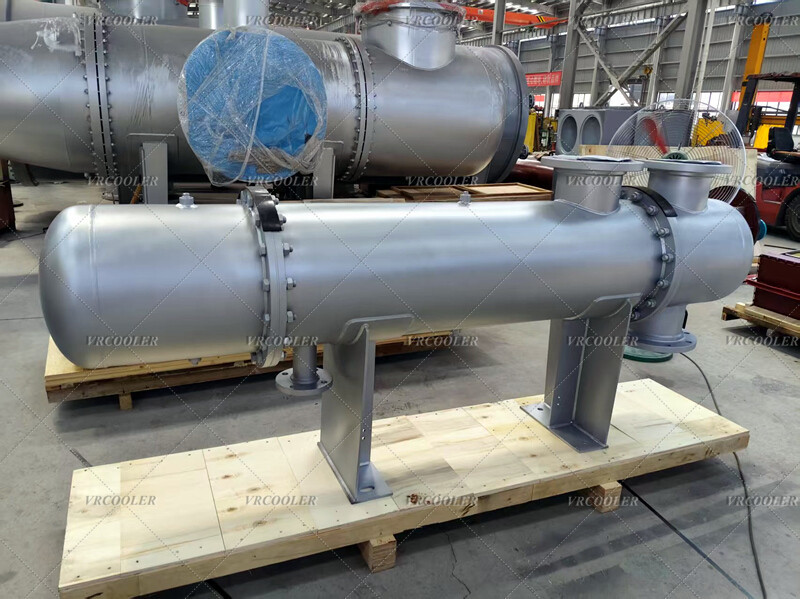
The thermal performance and service life of a fresh-water cooler tube bundle (shell-and-tube heat exchanger core) are influenced by several mechanical, operational, and environmental factors.
1. Heat Transfer Surface Area
Tube length, quantity, and arrangement
Tube diameter and wall thickness
Fin type (if finned tubes are used)
More surface area typically improves cooling capacity.
2. Tube Material and Thermal Conductivity
Cu-Ni, stainless steel, titanium, carbon steel
Higher thermal conductivity materials (e.g., Cu-Ni) improve heat transfer efficiency.
Material choice also affects corrosion resistance, which directly impacts long-term performance.
3. Flow Rates on Both Sides (Tube Side & Shell Side)
Performance depends on achieving proper flow velocity:
Low flow → poor turbulence and poor heat transfer
Excessive flow → tube erosion, vibration, and noise
Correct sizing ensures optimal turbulence without damaging the tubes.
4. Temperature Difference (ΔT) Between Hot and Cold Fluids
Heat transfer rate increases with a larger temperature gradient between tube-side freshwater and shell-side cooling water (or seawater).
5. Fouling, Scaling & Corrosion
Deposits inside or outside tubes dramatically reduce performance by:
Blocking flow
Increasing thermal resistance
Accelerating corrosion
Water quality, hardness, suspended solids, and chloride content are major contributors.
6. Baffle Design and Shell-Side Flow Pattern
Baffle spacing and arrangement influence turbulence and heat transfer efficiency.
Improper baffle design can lead to dead zones, reduced performance, or tube vibration.
7. Operating Pressure and Pressure Drop
Excessive pressure drop may indicate fouling or poor design.
Stable, appropriate pressure ensures consistent flow distribution and effective cooling.
8. Coolant Quality and Chemistry
For engine coolant (tube side):
Proper glycol concentration
Correct alkalinity
Use of corrosion inhibitors
For seawater cooling (shell side):Filtration
Anti-fouling measures
Poor coolant chemistry is one of the primary causes of tube failure and reduced performance.
9. Cleanliness and Maintenance Frequency
Performance declines steadily without regular:
Mechanical or chemical cleaning
Inspection for tube thinning or pitting
Anode replacement (if used)
10. Mechanical Condition of the Tube Bundle
Tube sheet integrity
Tube expansion/welding condition
Tube deformation, cracking, or vibration wear
Any mechanical defect deteriorates heat transfer and may cause internal leakage.
