
The price of a 2507 shell-and-tube heat exchanger depends on much more than its heat-transfer capacity. Commercial 2507 normally refers to UNS S32750 super duplex stainless steel, and its material cost, fabrication requirements and quality-control procedures are considerably higher than those for carbon steel or 316L stainless steel.
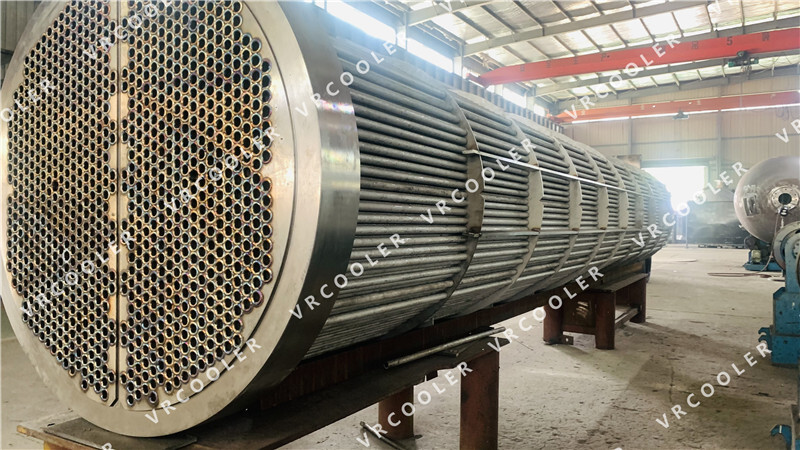
Heat-transfer capacity and exchanger size
The required duty determines the heat-transfer surface area, tube count, tube length and shell diameter. Low temperature differences, high fouling allowances or poor fluid heat-transfer properties require a larger exchanger and therefore more 2507 material.
Scope of 2507 construction
Price varies significantly according to which components are manufactured from 2507. Possible arrangements include:
- 2507 tubes only, with a carbon-steel shell
- 2507 tubes and solid 2507 tube sheets
- 2507 tubes with 2507-clad or weld-overlay tube sheets
- Complete 2507 construction, including the shell, heads, nozzles, baffles and fasteners
Using 2507 only for surfaces exposed to the corrosive fluid can substantially reduce the initial cost. However, the suitability of dissimilar materials must be checked for galvanic corrosion and cross-contamination risks.
Tube specifications
Tube outside diameter, wall thickness, length and quantity directly affect material consumption. Seamless tubes usually cost more than welded tubes, while thin-wall tubing may reduce material cost but requires careful mechanical and corrosion evaluation. U-bent tubes, special tolerances and long continuous tube lengths can also increase production costs.
Operating pressure and temperature
Higher design pressures require thicker shells, heavier channels, reinforced nozzles, stronger flanges and thicker tube sheets. Vacuum operation may require additional shell reinforcement. Extreme temperatures or large temperature differences can also require expansion joints, a floating head or a U-tube bundle.
Mechanical configuration
A fixed-tube-sheet exchanger is generally less expensive than a removable-bundle design. Floating-head exchangers usually have the highest initial cost because of their additional components and complex fabrication, but they provide easier mechanical cleaning and better accommodation of thermal expansion.
The number of tube passes, removable covers, inspection openings, impingement plates, bundle supports and special nozzle orientations also influence the final price.
Fabrication and welding requirements
Super duplex stainless steel requires controlled fabrication to preserve the correct ferrite-austenite phase balance and corrosion resistance. The manufacturer must use qualified welding procedures, suitable filler metals, controlled heat input and interpass temperature, clean tools and proper shielding or backing gas.
Tube-to-tube-sheet strength welding, full-penetration welds, weld overlay, pickling, passivation and heat-tint removal add labor and quality-control costs.
Design codes and inspection
The required design and certification level can substantially affect pricing. Common requirements may include ASME Section VIII, TEMA, PED, NACE/ISO sour-service requirements or project-specific engineering standards.
Additional inspections may include positive material identification, ferrite measurement, dye-penetrant testing, radiographic or ultrasonic testing, eddy-current tube testing, hydrostatic testing and ASTM G48 corrosion testing. Third-party inspection and detailed material traceability also add cost.
Fluid corrosiveness and fouling tendency
Chloride concentration, operating temperature, pH, oxygen content, solids, acids and cleaning chemicals affect the required material scope and corrosion design. Heavily fouling fluids may require larger tubes, wider tube pitch, a removable bundle or a floating-head construction, increasing the exchanger size and price.
Accessories and documentation
Insulation, saddles, lifting lugs, davits, spare gaskets, instruments, temperature sensors, pressure gauges and control valves affect the total package price. Detailed calculations, drawings, welding documentation, inspection plans, material certificates and multilingual manuals also require engineering time.
Order quantity and delivery requirements
A single customized exchanger generally has a higher unit cost than multiple identical units. Urgent delivery, uncommon tube sizes, limited 2507 material availability, special export packaging and long-distance transportation can further increase the price.
For an accurate quotation, the manufacturer requires the fluid compositions, flow rates, inlet and outlet temperatures, design pressures, allowable pressure drops, fouling factors, corrosion data, construction type, material scope, design code and inspection requirements. Although 2507 has a higher initial cost, its resistance to chloride corrosion and stress-corrosion cracking can reduce tube failures, shutdowns and replacement expenses over the exchanger’s service life.
