MESSAGE
What information is required to design a flooded evaporator?
Time :Aug 20, 2026
Designing a flooded evaporator requires complete thermal, hydraulic, mechanical, and operating data. The essential information includes:
- Cooling duty: Required capacity in kW, refrigeration tons, or kcal/h.
- Refrigerant: Refrigerant type, evaporation temperature and pressure, required superheat, circulation method, and available refrigerant charge.
- Chilled fluid: Water, brine, or water-glycol type, including glycol concentration and thermophysical properties.
- Fluid temperatures: Chilled-fluid inlet temperature and required outlet temperature.
- Flow conditions: Fluid flow rate, allowable velocity, and minimum and maximum operating flow.
- Pressure drop: Maximum permitted pressure loss through the chilled-fluid circuit.
- Operating range: Minimum, normal, and maximum cooling loads, including startup and part-load conditions.
- Fouling allowance: Expected water quality, scaling tendency, corrosion risk, and required fouling factor.
- Design conditions: Operating and design pressures and temperatures for both the refrigerant and chilled-fluid sides.
- Construction materials: Required shell, tube, tubesheet, gasket, and nozzle materials based on refrigerant compatibility and water chemistry.
- Refrigerant-level control: Float valve, electronic control valve, level sensor, surge drum, or liquid-separator arrangement.
- Oil management: Expected oil carryover and the required oil-drain or oil-return system.
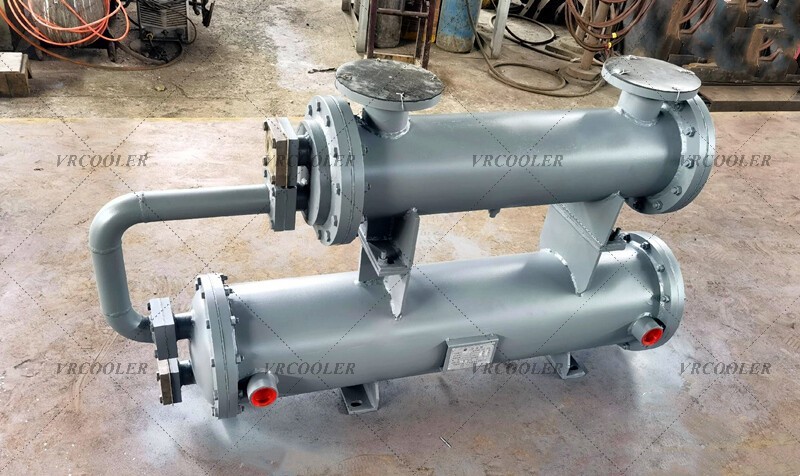
- Mechanical requirements: Overall dimensional limits, installation orientation, tube-removal space, mounting supports, lifting points, and insulation requirements.
- Connections: Nozzle sizes and locations, flange standards, drain and vent connections, instrumentation ports, and refrigerant inlet and vapor-outlet arrangement.
- Applicable standards: Required design codes, inspection requirements, pressure-vessel certification, hazardous-area classification, and local refrigerant regulations.
For a replacement flooded evaporator, existing drawings, nameplate data, nozzle locations, mounting dimensions, and verified operating records are also important. Actual performance data—such as chilled-water temperatures, refrigerant pressure, flow rate, approach temperature, and pressure drop—can help determine whether the original unit should be duplicated or thermally upgraded.