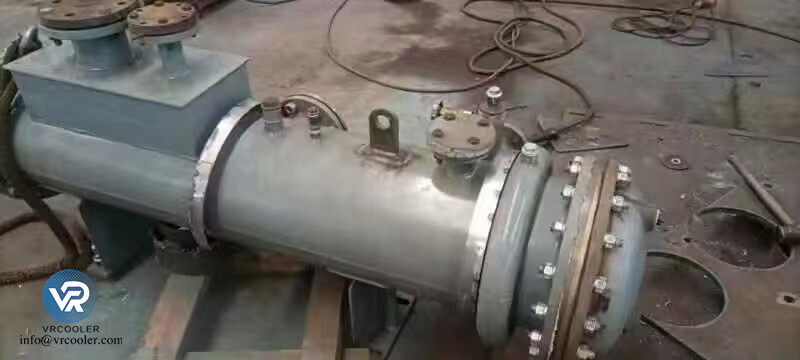
A marine atmospheric condenser and a vacuum condenser both remove heat from vapor and turn it into liquid, but they are designed for different operating pressure conditions and system purposes.
A marine atmospheric condenser usually works at or close to atmospheric pressure. It is mainly used in shipboard auxiliary systems, marine refrigeration systems, freshwater generation support systems, and vapor recovery applications where the vapor does not need to be condensed under deep vacuum. The structure is often simple and robust, with seawater or freshwater flowing through the tubes and vapor condensing on the shell side. Its main advantages are stable operation, easy maintenance, and good suitability for marine cooling-water conditions.
A vacuum condenser, on the other hand, operates below atmospheric pressure. It is used when the process requires vacuum evaporation, low-temperature boiling, vacuum distillation, or improved vapor recovery. Because the internal pressure is lower, vapor can be generated and condensed at a lower temperature. This is important in systems where high temperature may damage the product, reduce efficiency, or cause scaling. Vacuum condensers must have better sealing performance, reliable air removal, and proper control of non-condensable gases.
The biggest difference is the operating pressure. A marine atmospheric condenser handles vapor condensation under normal or near-normal pressure, while a vacuum condenser is designed to work under negative pressure. This pressure difference affects the condenser structure, sealing requirements, air venting design, condensate drainage method, and overall system control.
In marine applications, an atmospheric condenser is often selected when the system needs a durable and easy-to-maintain condenser for general vapor condensation. A vacuum condenser is selected when the system needs to maintain vacuum conditions, lower the evaporation temperature, or improve recovery efficiency. For example, in a marine freshwater generator, vacuum operation allows seawater to evaporate at a lower temperature, so the condenser must support stable vacuum performance and efficient condensation.