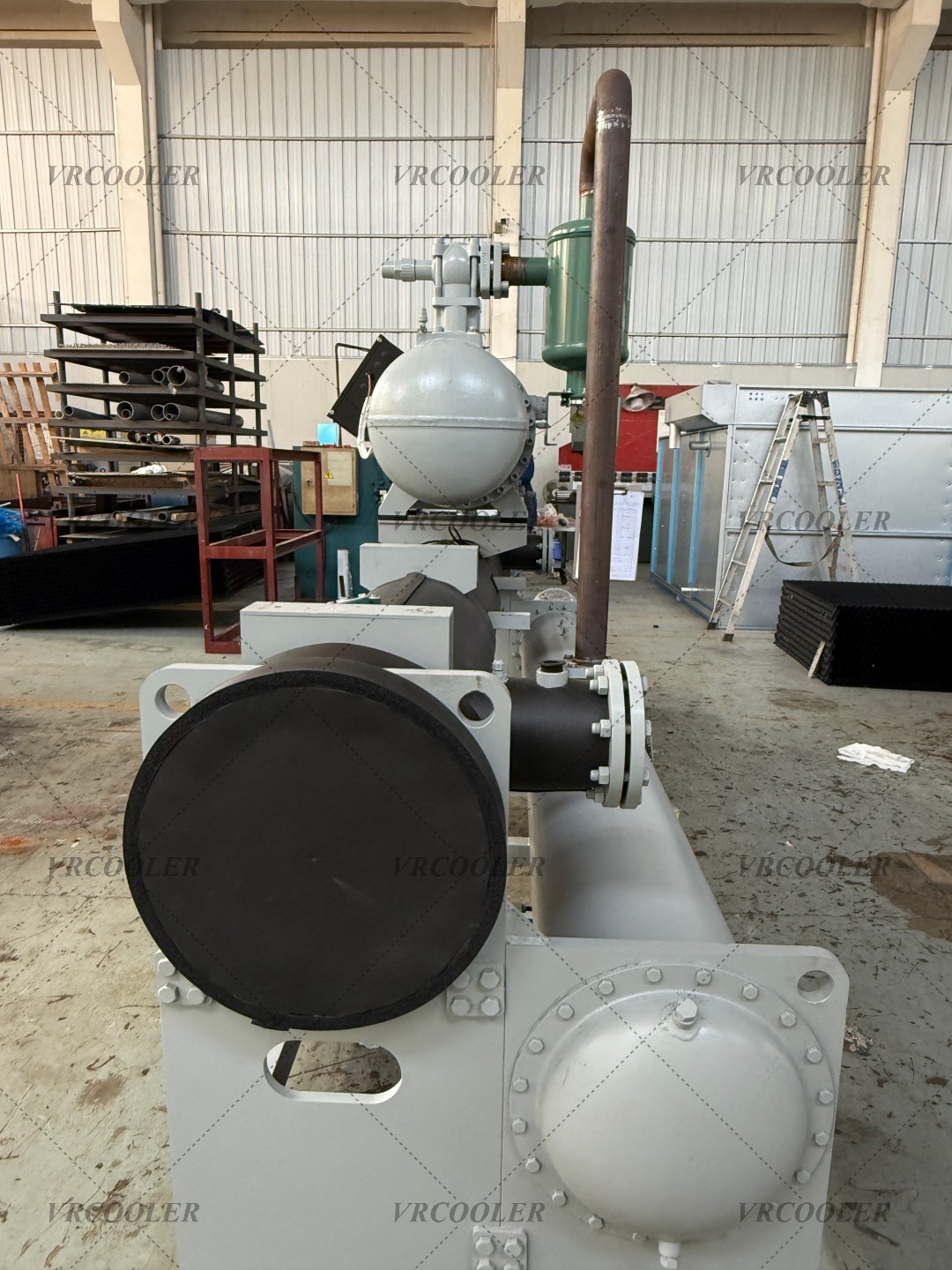
The main benefit of using a shell and tube heat exchanger in a water chiller is that it provides stable, efficient, and reliable heat transfer for continuous cooling operation. In a water chiller system, the heat exchanger is one of the most important components because it directly affects cooling capacity, energy efficiency, compressor performance, water temperature stability, and long-term system reliability.
When used as a shell and tube evaporator, the heat exchanger removes heat from chilled water or glycol solution. The refrigerant absorbs this heat and evaporates, allowing the chiller to supply low-temperature water to air handling units, fan coil units, process machines, data centers, production lines, or other cooling terminals. When used as a shell and tube condenser, it removes heat from the hot refrigerant gas discharged by the compressor and transfers that heat to cooling water. This allows the refrigerant to condense properly and continue the refrigeration cycle.
One major advantage of the shell and tube structure is its strong mechanical design. It can handle high water flow rates, large cooling capacity, pressure fluctuations, and long operating hours. This makes it especially suitable for commercial buildings, industrial plants, hospitals, hotels, district cooling systems, food processing factories, plastic injection molding, chemical production, and other applications where the chiller must run safely and continuously.
Another important benefit is easy maintenance. The tubes can be cleaned mechanically or chemically when scaling or fouling occurs. Compared with some compact heat exchangers, a shell and tube heat exchanger is more convenient to inspect, descale, repair, or retube. This is very important for water chillers because poor heat transfer can increase compressor load, raise energy consumption, reduce cooling capacity, and shorten equipment life.
Shell and tube heat exchangers also offer flexible material selection. For normal HVAC chilled water systems, copper tubes and carbon steel shells are commonly used. For seawater, brine, glycol, or corrosive water applications, stainless steel, titanium, Cu-Ni, or special alloy tubes can be selected. This allows the heat exchanger to be designed according to the actual water quality and operating environment.
In simple terms, a shell and tube heat exchanger helps the water chiller operate with stable cooling performance, good heat transfer efficiency, easy maintenance, and long service life. It is a reliable choice for both commercial HVAC chillers and heavy-duty industrial process cooling systems.