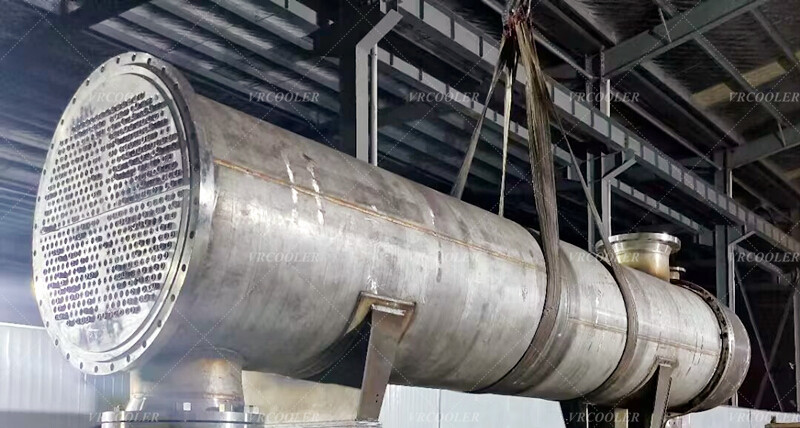
The main function of an overhead condenser in carbon capture is to cool the hot vapor leaving the solvent regenerator and condense the recoverable liquid components, mainly water vapor and small amounts of solvent vapor. In an amine-based carbon-capture system, the rich solvent absorbs CO₂ in the absorber and is then sent to the regenerator. Inside the regenerator, heat is supplied to release CO₂ from the solvent. The vapor leaving the top of the regenerator usually contains CO₂, water vapor, trace amine vapor, and other non-condensable gases.
The overhead condenser removes heat from this vapor stream and condenses the water and solvent vapor into liquid. This condensate can be separated and returned to the regenerator or solvent circulation system, while the CO₂-rich gas continues to downstream treatment, compression, drying, liquefaction, or storage. By recovering condensate, the condenser helps reduce water and solvent loss, improve solvent balance, and lower operating cost.
Another important function is to help control the regenerator overhead temperature and pressure. Stable condensation keeps the stripper operating under proper process conditions, which is important for consistent CO₂ release and lean solvent quality. If the overhead condenser is undersized or fouled, the regenerator pressure may rise, condensation may become incomplete, and the CO₂ outlet stream may carry too much moisture or solvent vapor.
A well-designed overhead condenser also protects downstream CO₂ equipment. Excess moisture or amine carryover can increase corrosion risk in piping, separators, dryers, and CO₂ compressors. It may also cause operational problems such as compressor fouling, unstable drying performance, higher maintenance demand, and reduced system reliability. For this reason, the overhead condenser is not only a cooling device, but also an important protection component in the carbon-capture process.
In practical design, the condenser must be selected according to vapor flow rate, CO₂ content, water vapor load, solvent type, cooling water temperature, required outlet condition, pressure drop limit, corrosion risk, and non-condensable gas content. Shell and tube overhead condensers are often selected because they provide strong mechanical construction, reliable heat transfer, flexible material options, and good suitability for continuous operation in amine and CO₂ service.